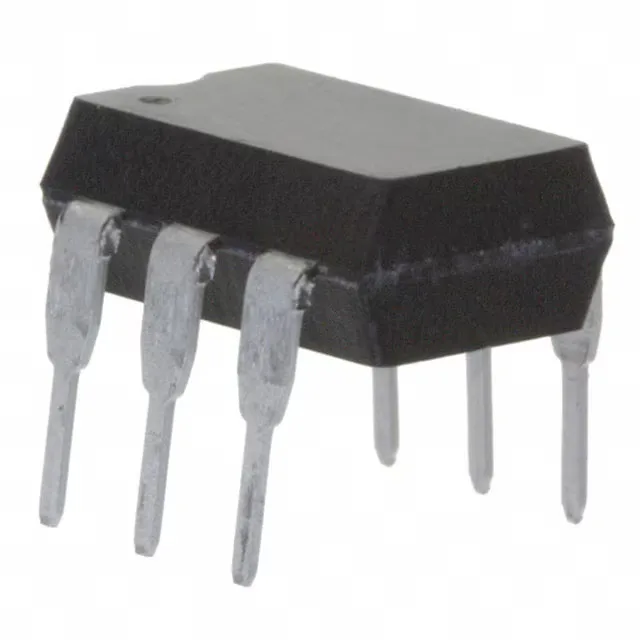
What the 5000Vrms isolation and CTR range mean for your BOM
The Vishay CNY75GC is a single-channel optocoupler with a phototransistor output that includes a base terminal — a detail that matters if you need to tailor switching speed or bias the transistor for a specific collector current. The 5000Vrms isolation rating is the headline safety spec: it defines the reinforced insulation barrier for industrial PSU feedback loops, motor-drive interface isolation, or medical equipment where patient-contact isolation is required. The 160% to 320% current transfer ratio (CTR) at 10 mA forward current tells you the LED-to-transistor gain spread. At the minimum CTR of 160%, a 10 mA LED drive yields at least 16 mA collector current — enough to saturate a TTL/CMOS logic input through a pull-up resistor. But the 2:1 CTR spread means you must design the output pull-up and threshold for the worst-case minimum, not the typical. The base terminal lets you add a resistor to ground to speed turn-off or to set a bias point for linear operation, which the standard CNY75 (no base pin) cannot do.
Temperature range and package — where this part fits
The -55°C to 110°C operating temperature range covers military, avionics, and industrial environments where the ambient inside an enclosure can hit 85°C and the self-heating of adjacent power components pushes local temperature higher. The 6-DIP through-hole package is a legacy footprint that remains common in power supplies, relay drivers, and PLC I/O modules where through-hole assembly is preferred for vibration resistance or manual rework. The 70V output breakdown and 50 mA per-channel output current are sized for driving small relays, logic gates, or MOSFET gates through a base resistor — not for direct solenoid drive. The 300mV Vce saturation at rated current keeps dropout low in 5V or 3.3V logic circuits.
For dual-sourcing resilience, Vishay's CNY75 family includes several CTR-binned variants (CNY75A, CNY75B) that share the same 6-DIP footprint and 5000Vrms isolation — the key difference is the CTR range, so verify the min/max matches your design's LED drive budget before substituting.