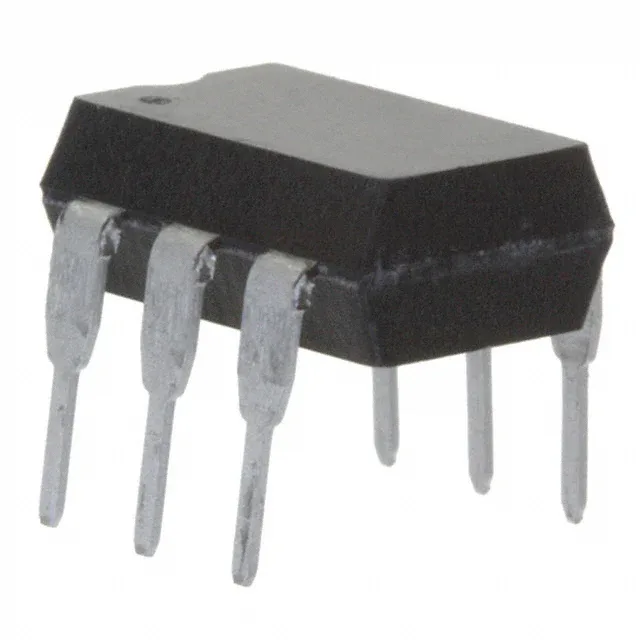
5000Vrms isolation — the barrier spec that decides the BOM
The Vishay CNY75B is a single-channel phototransistor optocoupler in a 6-DIP through-hole package. Its headline rating is 5000Vrms isolation voltage — the figure that tells you it belongs on the galvanic isolation barrier in motor drives, industrial PSU feedback loops, PLC I/O modules, and any equipment where a fault on the primary side must not reach the human interface or the low-voltage control logic. The transistor-with-base output gives you access to the base node for speed-up or bias tweaks, which the simpler phototransistor-only parts don't offer.
Current transfer ratio is specified as 100% minimum, 200% maximum at 10 mA forward current. That 2:1 spread is tighter than many general-purpose optos — it reduces the guesswork in LED drive current selection and keeps the output saturation voltage predictable across temperature and production lots. Vce(sat) is max 300 mV, so the output pulls cleanly to ground when the LED is on. Turn-on time is 5.5 µs typical, turn-off 4 µs; rise and fall are 3 µs and 3.7 µs respectively. That puts this part in the medium-speed class — fine for 10–100 kHz switching in isolated gate drives or status feedback, but not for high-speed digital isolation above 1 Mbps.
Output rating and temperature — where it survives
The output transistor is rated for 70 V collector-emitter and 50 mA continuous current per channel. This part is at home in outdoor telecom cabinets, engine-bay electronics, and downhole instrumentation where the commercial 0–70°C parts would drift or fail. The 60 mA max forward current on the LED side gives headroom for high-CTR-drop conditions at cold start.
Package and mounting — through-hole for serviceability
The 6-DIP (0.300", 7.62 mm pitch) through-hole package is the classic optocoupler footprint. It's a deliberate choice for designs where the isolation barrier must be physically robust — vibration, thermal cycling, and field replacement all favour the through-hole joint over a gull-wing lead.
Lifecycle and compliance — still a current part
ROHS3 compliant, so no conflict with EU or similar restricted-substance regulations.