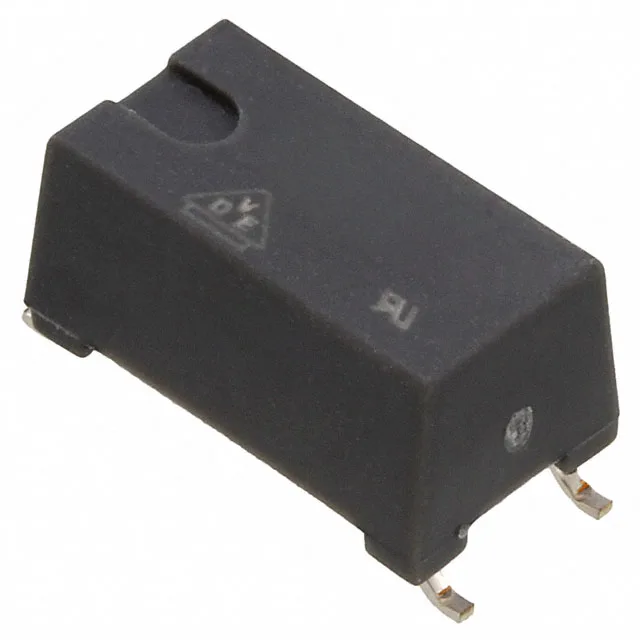
8200 Vrms isolation — what it buys you
The Vishay CNY64AYST is a single-channel optocoupler with a transistor output, built for applications that need reinforced isolation between a DC input and a logic-level or low-power load. Its headline rating is 8200 Vrms of isolation voltage — that places it in the high-isolation tier, suitable for medical patient-contact interfaces, industrial motor-drive feedback paths, or any circuit where a fault on the primary side must not propagate to the secondary. The 4-SMD Gull Wing package is a surface-mount format that reflows onto the board alongside other passives, saving a hand-solder step.
CTR range — the design decision it drives
Current transfer ratio is specified as 50% minimum and 150% maximum, both at a forward current of 5 mA. That 3:1 spread means the designer must bias the LED drive and size the collector load resistor for the worst-case minimum CTR, not the typical. If the circuit needs to guarantee a logic-high at the output with 5 mA on the input, the 50% floor sets the pull-up resistor value. The 150% ceiling tells you the output can saturate harder than expected, which matters if you are driving a sensitive gate input without a clamp.
Temperature range and output drive
The output transistor is rated for 50 mA continuous per channel with a maximum Vce of 32 V, and saturation voltage tops out at 300 mV. Rise and fall times are 2.4 µs and 2.7 µs typical.
It is ROHS3 compliant. The laser etch on the package body should trace cleanly to a Vishay date code; given the active status, the likelihood of encountering re-marked or sanded stock through the independent channel is low, but a quick decap or X-ray on a sample lot from a new supplier is still the prudent screen before committing a production run.