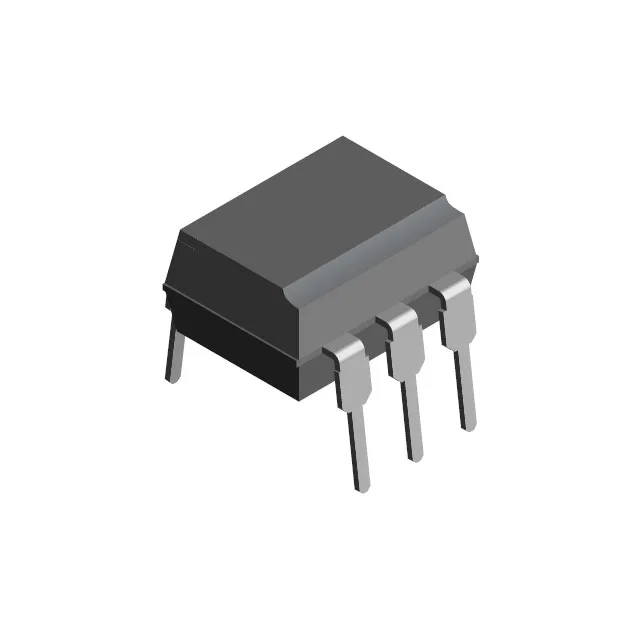
The Vishay CNY117-4 is a single-channel, DC-input optocoupler with a phototransistor output that brings the base terminal out to a separate pin. The 5000Vrms isolation rating qualifies it for reinforced insulation in mains-referenced circuits — think industrial AC motor drives, off-line switch-mode power supply feedback loops, and PLC I/O modules where the control side must stay galvanically separated from the field wiring. The transistor-with-base output gives you the option to bias the base for faster switching or to tailor the gain, which is useful when you need to balance CTR against switching speed in a given load condition.
The current transfer ratio is specified at 10 mA forward current: minimum 160%, maximum 320%. That is a fairly wide spread — about 2:1 — so if you are driving a logic input or a gate, you need to design the pull-up and the load resistor for the minimum CTR case to guarantee the output saturates. The 70V output transistor ceiling and 50 mA per-channel current rating give you headroom for driving small relays or DC loads directly, but watch the saturation voltage: 400 mV max at the rated current means you lose some voltage across the output, so a 5 V load sees about 4.6 V when the transistor is on.
Rise and fall times are 2 µs typical each; turn-on is 3 µs typical, turn-off 2.3 µs. That puts this part in the medium-speed class — fine for 10–100 kHz PWM feedback or serial data at a few hundred kHz, but not for high-speed digital isolation. If you need sub-microsecond edges, you would step up to a logic-output optocoupler or a digital isolator. The base pin lets you add a resistor to ground to speed up turn-off by sweeping out stored charge, which is a common trick in motor-drive desaturation detection circuits.
The 6-DIP through-hole package (0.300 inch row spacing, 7.62 mm) is about as rework-friendly as it gets. No moisture sensitivity level to worry about — standard DIPs are generally MSL 1. If you are replacing one on a populated board, a hot-air pencil or a desoldering station lifts it cleanly without lifting the plated-through hole pads. The through-hole format also means it survives repeated thermal cycles in field repairs better than a gull-wing SMD part, which matters for industrial equipment that gets serviced in the field.
Because it is a through-hole DIP — a package that has been in continuous production for decades — the supply base is broad and stable.