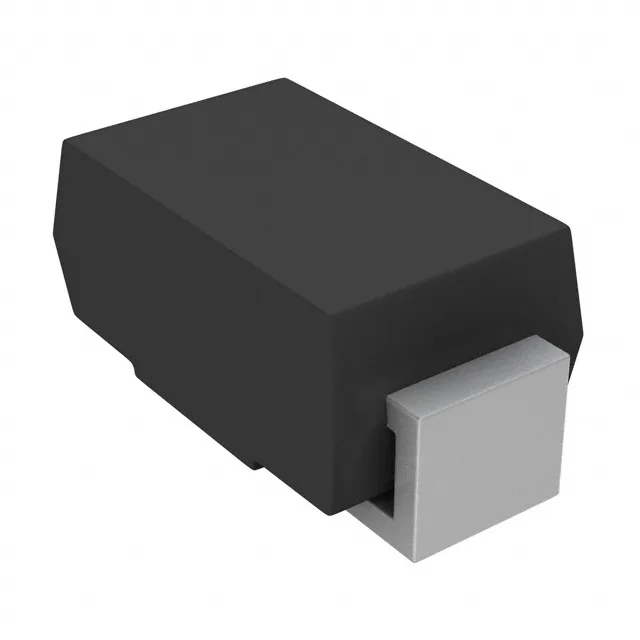
Vishay BYG10M-E3/TR3

BYG10M-E3/TR3 Avalanche Diode, 1 kV 1.5 A, DO-214AC (SMA)

MPNBYG10M-E3/TR3
End of Life

Vishay BYG10M-/TR3, Avalanche Diode, Standard Recovery >500ns, 1000 V, 1.5 A, DO-214AC (SMA), Surface Mount, Tape & Reel.

$0.4Ref. price · indicative, final on quote
PackagingDO-214AC, SMA
StockContact for availability
MOQ1 pcs
  • 100% new & originalTraceable channels only — no refurbs, no pulls, no remarked parts.
  • Date & lot codes on quoteStated per line before you commit; label photos on request.
  • MSL-compliant ESD packingMoisture-sealed bags with indicator cards; reels photo-verified.
  • PayPal buyer protectionPay by T/T, PayPal or Payoneer — card payments covered end to end.

Specifications

BYG10M-E3/TR3 Technical Specifications
ParameterValue
Diode typeAvalanche
Mounting typeSurface Mount
Voltage - DC reverse (Vr)1000 V
Voltage - forward (Vf) (Max) @ if1.15 V @ 1.5 A
Current - reverse leakage @ vr1 µA @ 1000 V
Current - average rectified1.5A
Operating temperature - junction-55°C ~ 150°C
SpeedStandard Recovery >500ns, > 200mA (Io)
PackageTape & Reel (TR); Cut Tape (CT)
CaseDO-214AC, SMA
Reverse recovery time4 µs

Product details

1 kV avalanche rectifier in an SMA package

The BYG10M-E3/TR3: The BYG10M-/TR3: The Vishay BYG10M-/TR3 is a standard-recovery avalanche diode rated for 1000 V reverse voltage and 1.5 A average rectified current, housed in a DO-214AC (SMA) surface-mount package. The avalanche construction means it can safely clamp and dissipate reverse-energy transients without failing — a key difference from a plain rectifier that would break down destructively under the same surge. This part is used in power-supply secondary rectification, snubber networks, flyback clamp circuits, and any 1 kV-class DC bus where the load can kick back energy.

4 µs reverse recovery — what it rules out

The reverse recovery time is 4 µs, which classifies this as a standard-recovery (>500 ns) diode. That trr is fine for 50/60 Hz mains rectification, bulk capacitor charging, and DC bus freewheeling at line-frequency rates. It is not suited for high-frequency switch-mode power supplies running above a few tens of kHz — the recovery tail would cause excessive switching loss and ringing. For a 100 kHz PFC boost or LLC converter, look at an ultrafast or SiC diode instead. The 1 µA reverse leakage at 1000 V is tight for a 1.5 A part and helps keep standby power low.

Forward drop and thermal budget

Maximum forward voltage is 1.15 V at 1.5 A, 25 °C junction. At 1.5 A that is about 1.7 W conduction loss — the SMA package dissipates that comfortably on a standard FR-4 pad, but the junction temperature must stay within the -55°C to 150°C operating range. The DO-214AC (SMA) footprint is shared with many 1 A to 2 A rectifiers, so this part drops into existing layouts without a board spin.

Frequently asked questions

What is the reverse recovery time of BYG10M-/TR3?

The reverse recovery time (trr) is 4 µs, which places it in the standard-recovery category (>500 ns). This is suitable for line-frequency rectification but not for high-frequency switching converters.

Can BYG10M-/TR3 be used in high frequency circuits?

No — the 4 µs reverse recovery time makes it unsuitable for high-frequency switching. It is designed for 50/60 Hz mains rectification, snubber circuits, and DC bus freewheeling where switching frequencies stay below a few kilohertz.