Isolation voltage and CTR — the two numbers that decide the fit
The 6N136-X019T is a Vishay single-channel optocoupler with a transistor-with-base output, rated for 5300Vrms of isolation. That isolation voltage qualifies it for reinforced insulation in mains-connected circuits — think isolated feedback loops in switch-mode supplies, IGBT gate-drive interfaces, or any signal crossing a safety barrier where the working voltage stays under the 5300Vrms test ceiling. The current-transfer ratio is specified at 19% minimum with a 16mA forward current. That 19% floor is the number to design to after you budget CTR aging — the LED in any optocoupler fades over time, and a design that starts at 19% has less headroom than one starting at 50%. For a 5V logic input needing 2mA at the output, the input drive must supply at least 10.5mA through the LED to guarantee the output turns on at end of life.
Switching speed and output drive — what 200ns buys you
Typical turn-on and turn-off times are both 200ns, placing this part in the medium-speed optocoupler class. It is fast enough for 1MHz-ish data rates or PWM signals up to a few hundred kilohertz, but not a logic-level digital isolator for high-speed serial buses. The output is a phototransistor with the base brought out — that base pin lets you add a resistor to tailor the switching threshold or speed up the turn-off with a base-emitter shunt, a flexibility you lose in a Darlington or logic-output optocoupler. Maximum output current per channel is 8mA, and the output voltage tops out at 15V. That output stage drives CMOS or TTL logic inputs directly, but not a relay coil or an LED indicator without a buffer transistor.
Package, temperature range, and compliance
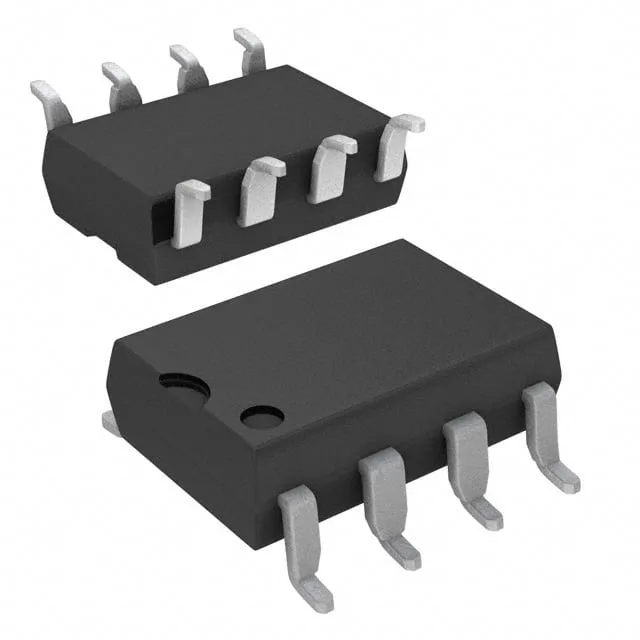
Housed in an 8-SMD Gull Wing package, the 6N136-X019T uses the standard SOP-8 land pattern common across the 6N136 family. The surface-mount gull-wing leads are inspectable after reflow and tolerate the thermal cycling of industrial environments. Operating temperature spans -55°C to 100°C, covering industrial and military-grade applications — motor drives, base-station power supplies, and outdoor instrumentation all fit within that window.