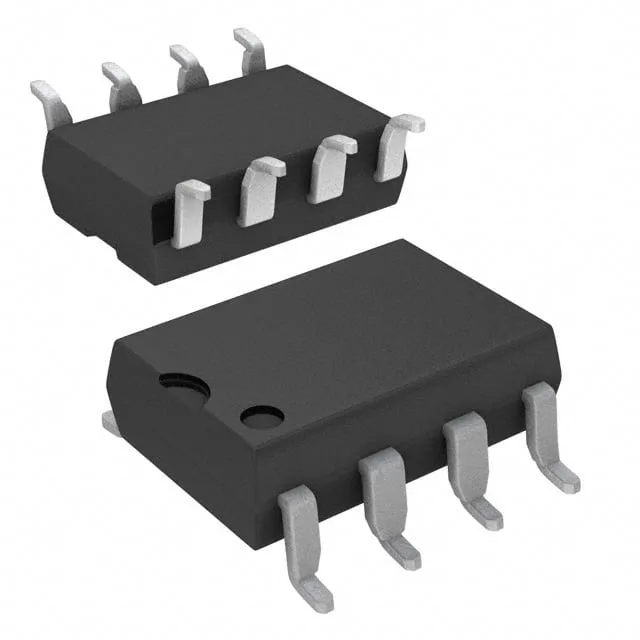
The 6N136-X007T is a Vishay single-channel optoisolator rated for 5300 Vrms isolation between input and output. That figure is the hipot test voltage, not the continuous working voltage — for a 240 VAC motor drive or an offline SMPS primary-to-secondary gap, this part gives you a safety margin well above the 2500 Vrms that most basic optos carry. The DC input side drives an LED at 1.33 Vf typical, and the output is a phototransistor with the base brought out to a pin. Having the base accessible lets you bias the transistor for faster switching or use it as a photodiode for analog feedback — a detail the repair bench appreciates when a board comes in with a blown output stage.
200 ns switching – fast enough for logic-level isolation
Turn-on and turn-off times are both 200 ns typical. That is fast enough to isolate a 5 MHz PWM signal from a microcontroller to a gate driver, or to pass a serial data stream like RS-232 at 115.2 kbaud without pulse-width distortion eating your bit timing. Slower optos like the 4N35 (several microseconds) would smear the edges. The minimum current transfer ratio is 19% at 16 mA forward current. At 16 mA LED drive, the output transistor can sink at least 3 mA — enough to pull a 5 V logic input low through a 1.5 kΩ pull-up. If your design runs the LED at lower current, the CTR drops; plan the LED resistor accordingly.
Active production – no LTB panic yet
Vishay lists the 6N136-X007T as Active. The 8-SMD gull-wing package is a standard footprint — no exotic land pattern that forces a board respin. The cut-tape and reel options cover both prototype and production runs.