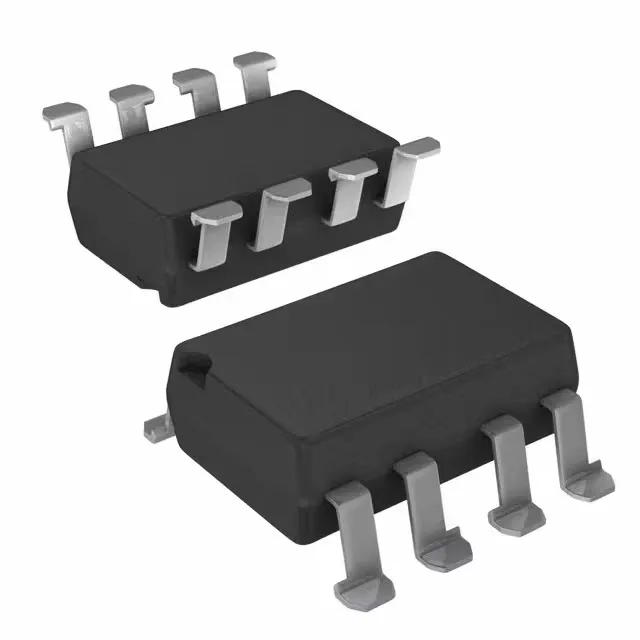
What the 5300 Vrms isolation rating means for your design
The 6N135-X007T is a single-channel optocoupler from Vishay that provides 5300 Vrms galvanic isolation between a DC input LED and a phototransistor output with a base connection. This isolation voltage is tested per IEC/UL standards and means the part can withstand a 5.3 kV transient between input and output without breakdown — sufficient for reinforced insulation in mains-connected industrial control interfaces, motor drive feedback, and isolated communication buses where the safety barrier must survive a surge event.
Switching speed and current transfer ratio — the two specs that decide fit
The 6N135-X007T guarantees a minimum current transfer ratio (CTR) of 7% at a forward current of 16 mA. This means the output transistor can sink at least 1.12 mA when the LED is driven at 16 mA — enough to pull a logic input low through a 10 kΩ pull-up to 5 V, but marginal for higher-speed or lower-power interfaces. The 300 ns typical turn-on and turn-off time sets the data rate ceiling at roughly 1.6 MHz in a saturated switching application; for faster protocols like CAN or RS-485, a logic-output optocoupler is a better fit. The output transistor is rated for a maximum collector-emitter voltage of 15 V and a continuous output current of 8 mA per channel. The base terminal is brought out, which allows the designer to add a base-emitter resistor to tailor the switching threshold or to use the transistor in a photodarlington configuration for higher gain — though the 7% minimum CTR already gives a clear lower bound on the transfer ratio at the specified forward current.
Rated for operation from -55°C to +100°C, the 6N135-X007T covers the full industrial temperature envelope and extends into the lower end of military-grade environments. The 8-SMD gull wing package (Supplier Device Package: 8-SMD) has a 1.27 mm lead pitch and a standard footprint that matches the DIP-8 through-hole layout with formed leads for surface mounting.