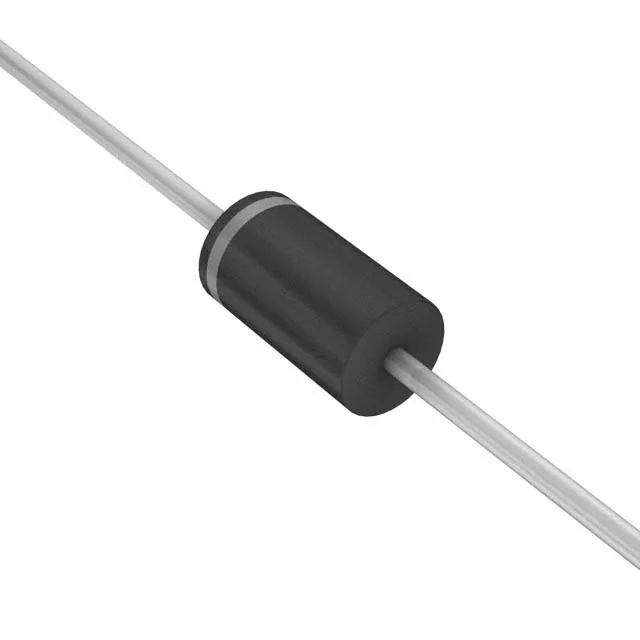
EOL automotive TVS diode — what the obsolete status means for your BOM
The 1N6279HE3/73 carries an Obsolete lifecycle status — no official successor or cross-reference appears in the Vishay General Semiconductor record. For a design still running this part, the migration path is a parametric check against the current 1.5KE TVS series lineup and a second-source qualification if the board layout permits a compatible substitute. Automotive AEC-Q101 qualification was the original selection driver — this is the TransZorb grade built for the -40 to +125°C ambient band found in engine-compartment and chassis-zone modules. The base product number 1N6279 groups this part into a family of bidirectional TVS ratings, which is the first place to look for a form-fit pin-compatible replacement if the current production source has dried up.
What the clamping specs mean for automotive transient protection
The reverse standoff of 17.8V is the working voltage the diode sees in normal operation — the line rides at or below this level without the device conducting. The clamping voltage of 31.9V maximum at the 47A peak pulse current is the voltage that appears across the protected load during a load-dump or inductive kickback event — this is the number that determines whether the downstream IC survives the transient. At 47A through the 31.9V clamping point, the diode is dissipating roughly 1.5 kW for the duration of the transient. The DO-201AA (DO-27) axial package handles this thermal spike because the lead frame acts as a heat sink during the pulse — a surface-mount TVS at the same rating would need a much larger footprint or a heatsink tab.
175°C junction temperature and the automotive grade
The AEC-Q101 grade means the part passed the automotive reliability stress battery: temperature cycling, high-temperature reverse bias, humidity, and mechanical lead integrity. This is not a commercial-grade diode that happens to be in an automotive datasheet — the screening and qualification flow is specific to the AEC-Q101 flow.