What the 1.5KE voltage triplet means for your protection circuit
The 1N6297A-E3/54: The 1N6297A-/54 sits in the 1.5KE series — Vishay's TransZorb® family of transient voltage suppressors. The three voltage specs that govern selection are the standoff (102 V typ), the breakdown threshold (114 V min), and the clamping ceiling (165 V max at 9.1 A peak pulse). Standoff is the maximum rail voltage the device can sit across continuously without conducting — the circuit should never exceed 102 V during normal operation. Once a surge pushes the line above 114 V, the TVS avalanches into conduction.
1500 W peak pulse in the 1.5KE series is rated against a 10/1000 µs waveform — a 10 µs rise time decaying over 1000 µs, which approximates the slow front of a power-line inductive kick or a distribution surge. That waveform is longer than the 8/20 µs fast-surge test used on larger TVS and MOV devices, so the 1.5KE is better matched to supply-line transients than to lightning-band surges. For a 24 V rail, a 1500 W device gives roughly 62 A of unclamped peak current capability before the clamping level is reached — more than adequate for most DC bus events. The unclamped peak current is not listed on this entry, but it is derivable from the clamping voltage and the 1500 W rating.
Junction temperature range and thermal headroom
The -55°C to 175°C junction temperature range on the 1N6297A-/54 is wide by consumer-electronics standards and well-suited to industrial and automotive adjacent environments. The upper limit is measured at the junction (TJ), not the ambient — in a sealed enclosure the actual junction temperature depends on the thermal resistance from junction to ambient and the dissipated surge energy. For a continuously exposed board in a panel, derate the available headroom accordingly. The DO-201AA axial package gives a longer thermal path to the leads than a SMD part, which helps spread heat into the PCB copper during repeated transients.
Package and board assembly
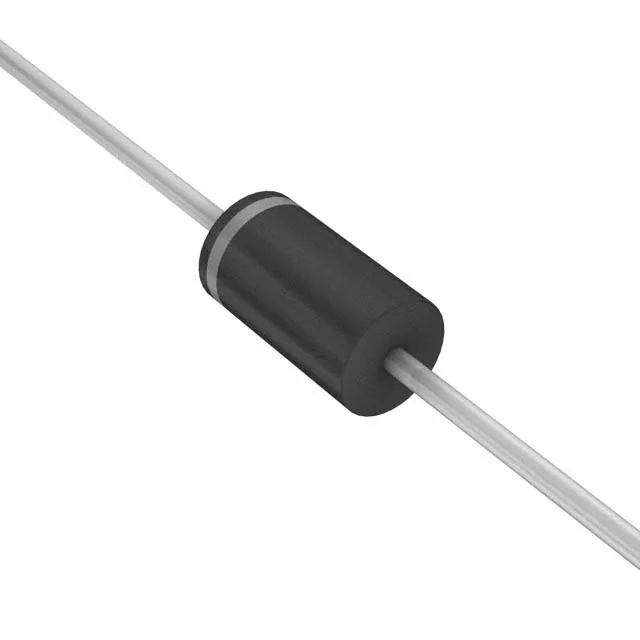
DO-201AA (also called DO-27) is the classic axial-leaded glass-body package for through-hole TVS diodes. The through-hole lead dress naturally filters high-frequency lead inductance — a real advantage over many SMD TVS packages for clamping performance on fast edges. Tape-and-reel and cut-tape options cover both high-volume automated insertion and hand-placement repair workflows. The axial body is easy to hot-air rework: both leads heat simultaneously and the body comes off without localised thermal stress on the package. Orientation is unambiguous — the cathode band marks the band-line end of the Zener.
What the series is not rated for
The entry lists Power Line Protection as No — this device is not a dedicated service-entrance surge protector and is not tested to IEC 61643-1 or equivalent power-line standards. It is a board-level unidirectional TVS for general-purpose protection of signal lines, control lines, and DC power rails up to its standoff voltage. For AC line-to-neutral protection, a higher-standoff bidirectional device or an MOV would be the correct choice. The single unidirectional channel clamps positive transients only; a bidirectional clamp for AC or bipolar rails requires a different polarity configuration.