Last Buy — what the lifecycle status means for your BOM
The 1N6279A-E3/51: The 1N6279A-/51 is listed Last Buy — the production run has closed and no further manufacturing is scheduled. TransZorb® is Vishay's TVS (Transient Voltage Suppressor) series — a Zener-based architecture optimised for clamping surge events rather than continuous regulation. The 'A' suffix denotes the tightest voltage tolerance band in the 1N6279 family.
What 1500 W and 49 A mean for the protection design
1500 W peak pulse power at 10/1000 µs waveform defines the surge energy the diode absorbs without degradation — this is the headroom above the clamping voltage that burns off the transient before the downstream circuit sees it. A 49 A peak pulse current at the same waveform sets the complementary ceiling for the fault current the device survives. The protection window runs 18.8 V reverse standoff (normal working voltage), 20.9 V minimum breakdown (where the TVS begins conducting), and 30.6 V maximum clamping voltage at the rated peak current. The gap between standoff and clamping is the voltage spike the downstream load must survive during the event — this window is the design axis for selecting the TVS in any power-supply or motor-drive input stage. With a 175 °C maximum junction temperature and a junction-to-ambient thermal path running through the DO-201AA leadframe, the axial body acts as a heat sink in free-air or clipped-lead configurations — a board-level thermal consideration the layout engineer must account for when the clamp event is sustained.
DO-201AA axial package and through-hole mounting
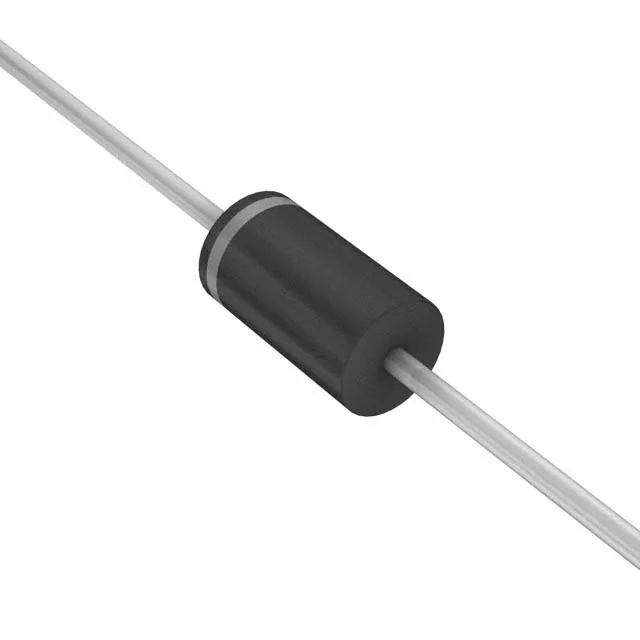
The DO-201AA (also called DO-27) is a long-lead axial package — the body sits off-board and the leads conduct heat away under surge conditions. This form factor suits panel-mount TVS protection on power-supply input rails and motor-drive DC bus clamping where the diode needs to be remote from the PCB, or where lead dress adds series inductance that shapes the clamping response.