Obsolete — independent-channel sourcing
The 1N6277-E3/73: This series (1.5KE) is a known Vishay family, so compatible alternatives in the same DO-201AA footprint may exist within the same series family, but there is no manufacturer-stated pin-compatible replacement in the ledger — a BOM engineer should confirm fit before substituting.
What the clamping specs mean for your circuit
The 14.5 V typical reverse standoff is the working voltage the line should sit below in normal operation, below which the TVS stays off and draws only leakage current. Breakdown at 16.2 V minimum means the Zener conduction threshold sits well below the clamping ceiling — the device turns on aggressively relative to the standoff, which is the right behavior for a clamping suppressor: you want the clamp to fire low and hard, not let the overvoltage plateau persist. Higher-energy transients (8/20 µs lightning pulses, for instance) reduce the achievable peak current at the same energy; check the V-I characteristic curve for those conditions.
DO-201AA package and series positioning
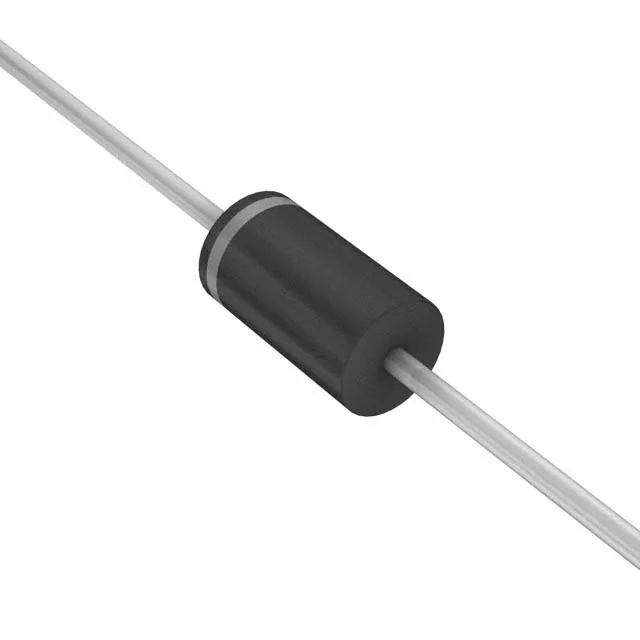
The DO-201AA axial package is the standard 1.5KE device footprint — wide-body glass passivated construction, intended for through-hole insertion on a PCB or chassis. The supplier device package field lists 1.5KE, which is the series designation Vishay uses for this power class of unidirectional TVS Zener. The -55°C to 175°C junction temperature rating covers the full military-industrial temperature band — the upper limit is junction-limited, so thermal resistance from the lead to the junction determines the actual continuous dissipation the part can handle at a given ambient. For a through-hole device in free air, the leads carry most of the heatsinking.
TransZorb family and unidirectional protection
The TransZorb® designation marks this as Vishay's original glass-passivated Zener TVS series — the glass passivation gives better stability under voltage stress than unmasked junction chips. It is a unidirectional device (one direction of protection), so it clamps only positive transients on the protected line; for bidirectional AC lines a dual-polarity TVS is required, and this part would not serve that role. General-purpose application designation means no specific industry-standard qualification (AEC-Q101 for automotive, MIL-PRF-19500 for defense) is cited — the part was targeted at commercial and industrial power-supply and electronics protection applications, not safety-critical or automotive domains without additional qualification on the buyer's part.