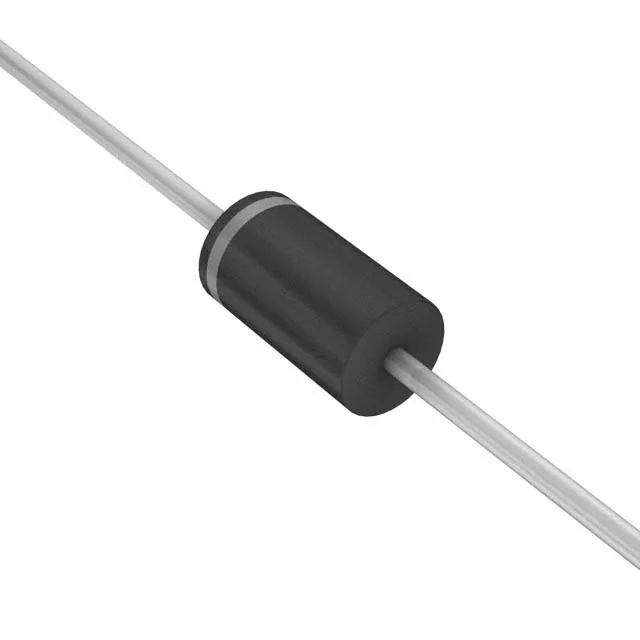
What the voltage and power ratings mean for surge protection
The 1N6276A-E3/73: The 15.2 V minimum breakdown is the threshold at which the device begins to clamp — any voltage spike exceeding it switches the TVS into its low-impedance conduction state and diverts the surge current away from the protected circuit. The 22.5 V maximum clamping voltage at the 66.7 A peak pulse current tells you the worst-case voltage the downstream load sees during a full-rated 10/1000 µs transient — this figure must stay below the absolute-maximum rating of whatever is being protected. Rated for 1500 W peak pulse at 10/1000 µs waveforms, the device absorbs the transient energy without degradation — the 13.6 V reverse standoff is the continuous working voltage in normal operation, below which the TVS sits idle and draws only leakage current. The TransZorb® series designation indicates Vishay's glass-passivated Zener-based construction — the passivation layer bonds the junction hermetically, which resists moisture ingress better than a bare junction in an equivalent unpassivated Zener — a meaningful difference in outdoor or humid environments.
Temperature grade and deployment context
-55 °C to 175 °C junction temperature rating puts this well into industrial and automotive adjacent territory — a board that sees prolonged solar loading, a power-stage heat soak, or a motor-drive enclosure without active cooling stays within the Tj window as long as the local ambient stays below the thermal derating curve. The DO-201AA axial package with through-hole mounting is the established through-hole form factor for higher-power TVS and rectifier diodes — it mounts directly to a PCB with generous lead gauge and tolerates wave or hand soldering without special reflow profile concerns. General-purpose classification means it is not characterised for automotive AEC-Q101 or aerospace JAN screening — use it where the application does not require AEC-qualified TVS, and where the -55 to 175 °C thermal margin covers the worst-case board environment.