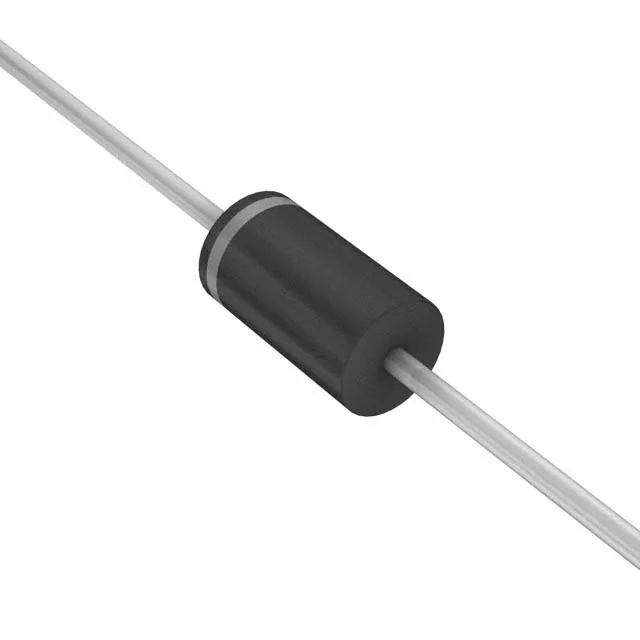
The 1N6271AHE3_A/D: 1500 W peak pulse at the 10/1000 µs wave shape is the defining rating for this part — it tells you the part survives a single 10/1000 µs transient (the automotive load-dump wave) at 1500 W without degradation, which translates directly to how much surge energy the downstream circuit sees before the clamp settles. On a 12 V automotive rail the nominal standoff is 8.55 V typ — the TVS sits idle during normal operation and turns on hard only when the line spikes above that threshold. The minimum breakdown of 9.5 V gives the window between normal operation and first turn-on, which is the designer's headroom for tolerance stack-up on the 12 V rail.
AEC-Q101 automotive qualification and thermal margin
The series designation Automotive, AEC-Q101, TransZorb® means this part passed the automotive discrete qualification stress battery — including humidity, temperature cycling, and surge life — under the AEC-Q101 standard, the discrete-semiconductor counterpart to AEC-Q100. The -55°C to 175°C junction temperature rating covers the full under-hood cold-crank to hot-soak band; an engine-bay ECU that runs at 150°C junction still has 25°C of margin before the thermal limit. The supplier device package is 1.5KE, which is the Vishay factory footprint code for this body style — the thermal resistance from junction to lead is set by the DO-201AA package geometry, so heatsinking calculations should reference the 1.5KE thermal curve, not a generic DO-201 estimate.
DO-201AA axial — board integration context
Through-hole DO-201AA (also called DO-27 in some sourcing systems) accepts hand or wave solder and provides generous lead-to-body clearance for high-current surge paths. The axial orientation and the tape-and-box packaging mean this part ships in a lead-form compatible with automated axial insertion — the tape pitch and lead straighten requirements for insertion equipment should be verified against the assembly tooling. The single unidirectional channel means this part clamps one polarity only; if bipolar protection is required a second part must be added in reverse series or a bidirectional variant selected from the same 1N6271 family.
The part carries an Active product status — it is not flagged as NRND or discontinued. The base product number 1N6271 groups it into the broader 1N6271 series, so alternative voltage choices within that family carry the same pinout and package.