What the clamping specs mean on the bench
The 1N6270AHE3_A/D clamps at 13.4 V maximum under a 112 A peak pulse (10/1000 µs waveform) — that 1.5 kW peak rating is the number that decides whether this part survives the load-dump event on a 12 V rail without the downstream IC seeing more than it can take. Reverse standoff sits at 7.78 V typical; breakdown minimum is 8.65 V — so there is a narrow guard band between the rail running normal and the device entering conduction, which is exactly what you want for a clamp that idles quietly until the transient arrives. Power line protection is marked No — this is a local rail clamp, not a bus protector; it belongs on a sensitive node, not across the main supply trunk.
Under-hood deployment — the AEC-Q101 angle
AEC-Q101 qualification means it passed the automotive stress suite — temperature cycling, humidity bias, and surge testing to the automotive transient profile, which is harsher than the IEEE surge spec used for commercial TVS devices. The 175°C maximum junction temperature gives headroom in engine-bay locations where ambient at the PCB can hit 125°C — with the derating curve factored in, the 1.5 kW peak is usable without the part self-destructing on the first hot soak. Automotive application designation signals the production part approval process (PPAP) documentation path is available from Vishay — relevant if you are specifying into an ECU or BCM BOM.
DO-201AA axial — board-level replacement reality
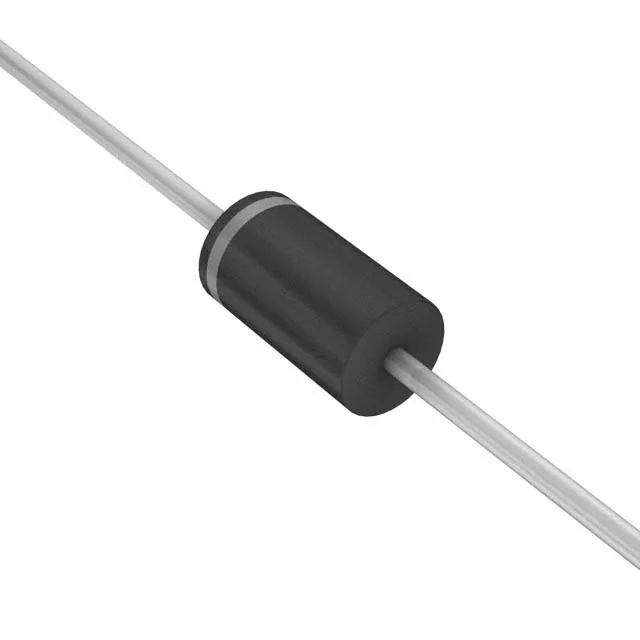
Through-hole DO-201AA (also called DO-27) is the workhorse automotive TVS package — the lead wire acts as its own heat sink path to the PCB pads, so the board layout and pad size directly affect the achievable peak pulse rating in the application. Tape-and-box packaging is the standard reel substitute for through-hole — it works in radial tape-and-reel handlers on standard assembly equipment and keeps the leads straight during kitting, which matters for high-volume automotive pick-and-place. The 1.5KE supplier device package designation groups this into the Vishay 1.5KE series footprint — the lead spacing and body dimensions are consistent across the series, so cross-referencing within the family for a different standoff voltage keeps the PCB footprint unchanged.