What the 1.5 kW peak-pulse rating means for telecom protection
The 1N6268AHE3_B/C: A telecom line card seeing 48 V supply noise on adjacent slots needs a TVS whose standoff covers the working voltage with margin and whose clamping ceiling keeps downstream silicon below its abs-max. At 1.5 kW the part handles the energy content of a fast transient without the diode going short-circuit under surge — a failure mode that trips downstream fuses rather than passing catastrophic current further into the backplane.
Automotive grade and TransZorb heritage
The -55 to 175 °C junction temperature range is the headroom that lets the part survive under-hood and engine-bay ambient swings without derating the clamping performance. The TransZorb® series is Vishay's internal TVS brand — it denotes a Silicon passivated junction with controlled avalanche characteristics, which is the mechanism that dissipates the surge energy when the diode clamps. For an automotive ECU that must survive ISO 7637-2 transients, that controlled-avalanche response is the compliance path.
Axial DO-201AA in tape-and-reel — what it means for assembly
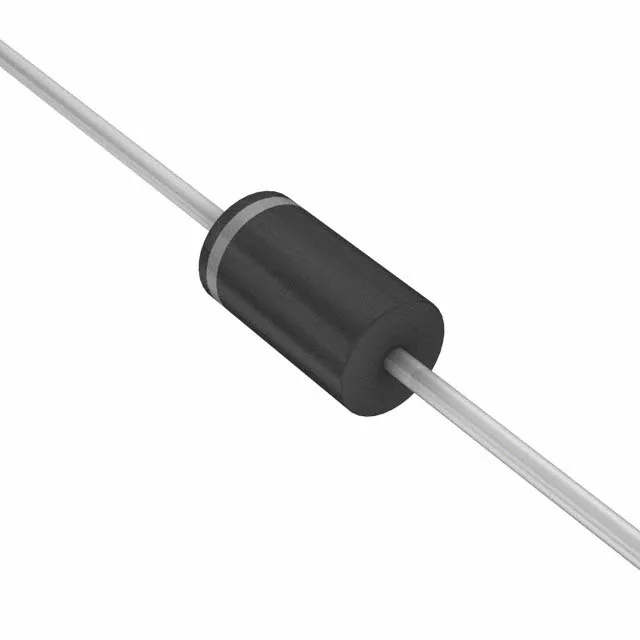
The DO-201AA (also called DO-27) is an axial leaded package — it mounts on a 5.08 mm (0.2 inch) lead spacing and solders through-hole. Tape-and-reel packaging is the format for automated insertion on legacy board lines that still run axial components rather than reflowing an SMD TVS. The through-hole barrel also gives a thermal path through the board vias to a ground plane — a TVS relying on avalanche dissipation needs that heat sinking to stay within the 175 °C junction limit on a loaded line card. For BOM consolidation: the 1.5KE supplier device package designation ties the part to a footprint and current rating family — any 1.5KE unidirectional TVS shares the same body dimensions and lead spacing, so alternate sources from the same family are mechanically drop-in if the standoff and clamping specs also match the board's protection target.