Clamping and standoff — what the surge ratings mean
The 1N6268AHE3_A/D is a unidirectional TransZorb® TVS diode — a voltage-clamping suppressor that dumps a surge into its clamping state before the protected node exceeds its breakdown ceiling. Reverse standoff is 6.4 V typ, the working rail the diode presents in normal operation; the minimum breakdown sits at 7.13 V, which means the device does not start clamping until the transient pushes the line above that threshold. At that pulse the clamping ceiling is 11.3 V, and the peak pulse current reaches 133 A; a downstream IC with an absolute maximum of 15 V sees at most 11.3 V during a transient event — well within margin.
Automotive grade and thermal margin
AEC-Q101 qualification places this part in the automotive discrete-semiconductor cohort — the same stress testing as AEC-Q100 but for diodes and discretes: HBM ESD class 2 minimum, temperature cycling, humidity bias, and operating life at the rated junction temperature.
Through-hole footprint and sourcing reality
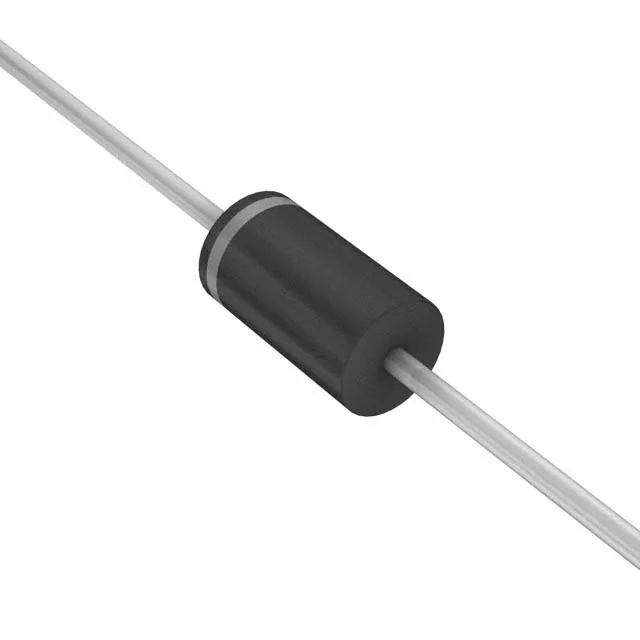
The DO-201AA axial body (DO-27 alias) mounts in the classic through-hole footprint — the lead bend radius and lead diameter suit both wave-solder and hand-solder assembly, and the axial geometry gives a natural thermal path through the leads to the PCB pad. Tape & Box packaging signals a distributor-friendly reel substitute; the supplier device package designation is 1.5KE, which is the Vishay case size used across the 1N6268 family. The part carries Active status under Vishay General Semiconductor - Diodes Division, with 1N6268 as the base product number. For a part in this family the sourcing posture is quoted-to-order through authorized and independent channels — no sole-source exposure on an active automotive-qualified line, but the 1.5KE case family is worth confirming against your approved alternate list before committing the BOM.