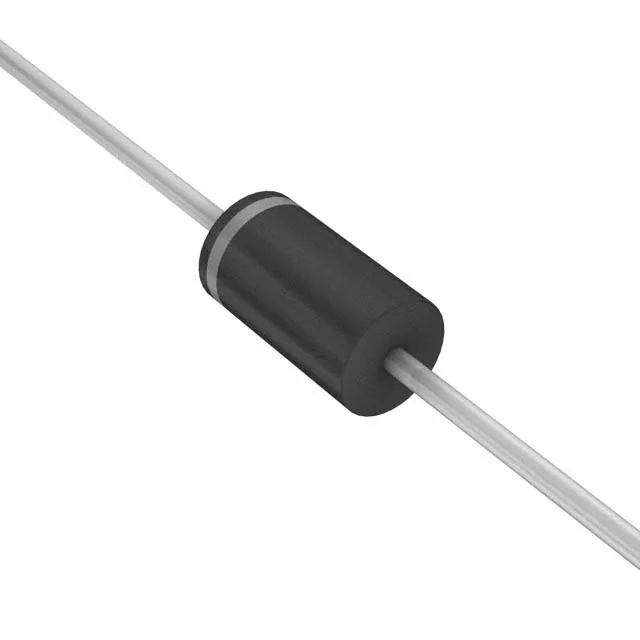
The 1N6268AHE3_A/C: The 1500 W peak pulse rating (10/1000 µs waveform) is the primary selection parameter for a TVS/TransZorb protecting an automotive supply rail — it defines the energy the device will absorb during a load-dump or inductive kick event without failing short. The standoff voltage of 6.4 V sets the working voltage the protected rail sees in normal operation; the breakdown minimum of 7.13 V is the threshold where the TransZorb begins to clamp, and the clamping voltage ceiling of 11.3 V at 133 A peak pulse is what the downstream circuitry actually survives. For an automotive ECU input or supply rail protection circuit, the 11.3 V clamp — not the 6.4 V standoff — is the stress number the downstream semiconductor sees.
TransZorb versus a standard Zener — series designation matters
The TransZorb series designation marks this as a Silicon Transient Voltage Suppressor — it behaves like a Zener in normal operation but is rated for a defined peak pulse power and current that a standard Zener diode is not. A standard Zener datasheet gives you Vz and Pz at continuous DC; the TransZorb datasheet gives you the peak pulse power curve (10/1000 µs and 8/20 µs), the clamping voltage at a specific peak current, and the AEC-Q101 automotive qualification flow. If you are specifying by Zener voltage alone, you may be undersizing the transient capability. For an ECU module that must survive under-hood temperature and voltage transients, an unrated Zener in the same voltage class is not a functionally equivalent substitute without independent qualification data.