What the clamping spec means in practice
The 1N6267A-E3/54: The 1N6267A sits at 5.8 V typical reverse standoff during normal operation — the circuit never sees the clamping voltage until a transient arrives. When the surge hits and the diode breaks down at 6.45 V minimum, it clamps the event to 10.5 V maximum while conducting 143 A peak pulse (10/1000 µs waveform). That 10.5 V ceiling is what protects downstream ICs and connectors on the rail. The 1500 W peak pulse rating defines the device's surge-handling envelope — it survives a single 10/1000 µs event at the rated current without degradation. Sustained or repeated transients above that energy floor shift the clamping characteristic, so the 1.5KE series is sized for the worst-case surge the enclosure or field wiring can inject, not the nominal operating voltage.
Why the temperature window matters
-55 °C to +175 °C junction temperature range puts this device in the class of parts that survive both cold-field environments and the thermal rise inside a sealed enclosure under surge. The 175 °C ceiling means the Tj calculation during a clamping event has real headroom before the datasheet limit closes — for a motor-drive cabinet that might see 100 °C ambient, the surge-induced temperature spike still lands comfortably inside the rating.
Package and where it fits
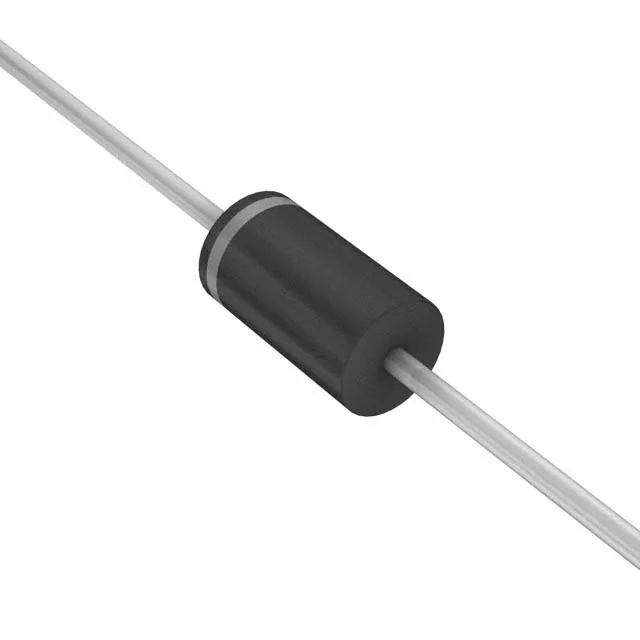
Axial DO-201AA (also called DO-27) is the through-hole TVS format that panels and power-supply boards have used for decades — it clips into a standoff or solders into a pigtail and the lead length adds inductance to the clamping response. For high-speed PCB-level suppression the lead parasitic matters; for mains-adjacent or connector-level protection the through-hole form factor is an advantage — it handles higher current density than a SOD-123 surface-mount counterpart with no solder-joint fatigue concern on thermal cycling.
Not a power-line device
The listing explicitly marks Power Line Protection as No. The TransZorb series is engineered for PCB-level transient suppression — protection of signal lines, low-voltage rails, and semiconductor nodes. It is not tested to the 1.2/50 µs combination-wave impulse used for power-line certification, so do not size this part for an AC-mains protection position without that confirmation.