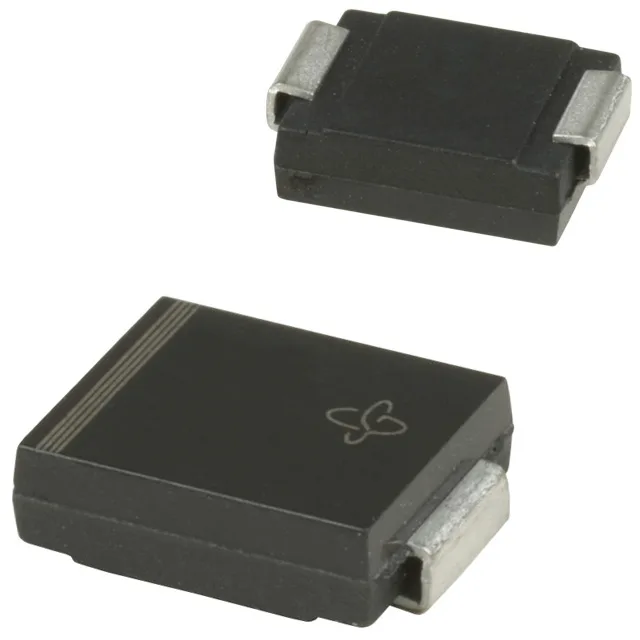
Vishay General Semiconductor - Diodes Division 1.5SMC91CAHM3_A/H — Circuit Protection

Vishay 1.5SMC91CAHM3_A/H TVS Diode, 77.8V Standoff, DO-214AB

MPN1.5SMC91CAHM3_A/H
Active

Vishay General Semiconductor, Automotive AEC-Q101 1.5SMC TransZorb® TVS diode, 77.8V reverse standoff, 1.5kW peak pulse, 12A peak pulse current, unidirectional DO-214AB (SMC), -65°C to 150°C junction, Tape & Reel.

Independent supplier — new & surplus stockAuthenticity-screened · ESD-safe packingListing updated Aug 2026

Specifications

1.5SMC91CAHM3_A/H specifications
ParameterValue
TypeZener
SeriesAutomotive, AEC-Q101, 1.5SMC, TransZorb®
MountingSurface Mount
Voltage - breakdown86.5V
Voltage - clamping (Max) @ ipp125V
Voltage - reverse standoff77.8V
Current - peak pulse (10/1000μs)12A
Power - peak pulse1500W (1.5kW)
Power line protectionNo
Operating temperature-65°C~150°C(TJ)
PackageTape & Reel (TR)
ApplicationsAutomotive, Telecom
CaseDO-214AB, SMC
Bidirectional channels1

Product details

What the 1.5SMC91CAHM3_A/H actually does

The 1.5SMC91CAHM3_A/H is a unidirectional Zener-based transient voltage suppressor — the TransZorb® construction sandwiches the Zener junction in a glass-passivated die coating that self-heals after a surge event, unlike a plain Zener which degrades under repeated overvoltage. A faster transient (8/20µs) delivers the same energy at a higher peak current because the pulse width is shorter; the part survives either, but the clamping voltage at a given waveform depends on the di/dt. For motor-drive and inductive kickback transients, budget the clamping voltage into your downstream IC's absolute-maximum rating — 125V is the ceiling at 12A, and it drops at lower let-through currents.

Why the AEC-Q101 grade changes the deployment window

The listed applications are Automotive and Telecom — telecom is a natural fit because the 77.8V standoff sits above the 48V common rail peak, and the 1.5kW rating covers the surge test waveforms specified in ITU-T K.44. For automotive, the part is suited to ECU input protection and CAN/LIN bus transient suppression where the clamping voltage at 12A must stay below the bus-transceiver absolute-maximum rating.

Package and what the DO-214AB form factor means on the board

Tape & Reel packaging is the standard automotive reel quantity — confirm with your EMS whether they require wound-reel orientation for auto-placement, since the cathode band orientation in the carrier tape matters for some pick-and-place vision systems that use the band as a fiducial marker.

Frequently asked questions

Is the 1.5SMC91CAHM3_A/H unidirectional or bidirectional?

Unidirectional — the CA suffix denotes a bidirectional configuration in standard 1.5SMC nomenclature, but the evidence lists 1 bidirectional channel, which reflects the single-polarity TVS clamping direction. Verify the CA/CAL suffix convention against the datasheet orientation: the unidirectional TVS clamps positive transients in one direction only; for bidirectional protection a dual-polarity variant (the plain 1.5SMC91A) or two opposite-polarity devices in series is required.