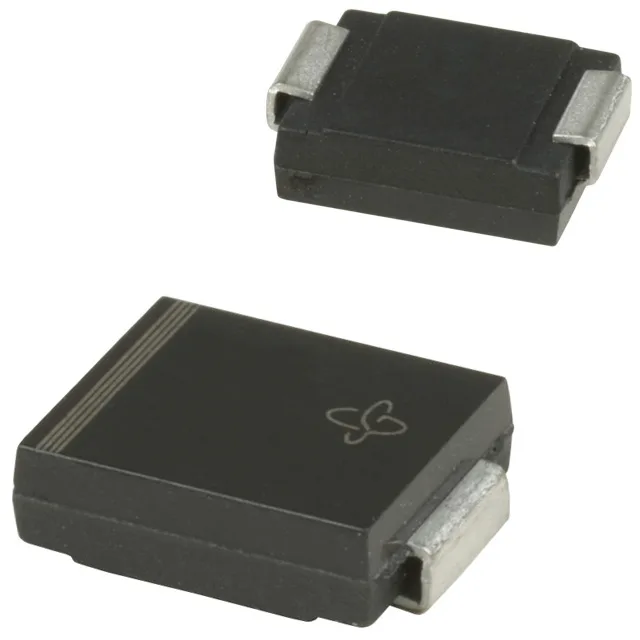
The 1.5SMC91CAHE3/9AT: The 1.5SMC series is Vishay's mid-range automotive Transient Voltage Suppressor line, sitting between the smaller 1.5KE family and the higher-power 5KP series. At 1.5 kW, it handles the load-dump and inductive-spike transients common in 12 V and 24 V automotive rails without requiring a larger, more expensive device. The peak pulse current of 12 A at 10/1000 µs is the other half of the absorption story — the clamping voltage of 125 V is specified at this current. Design to that clamping level, not the standoff voltage, when you are protecting a downstream IC. The clamp voltage is where the protected rail gets pushed during the event.
The three-voltage window: standoff, breakdown, clamping
The reverse standoff voltage of 77.8 V typical is the working rail the TVS sees continuously — the device sits reverse-biased at this level without conducting. The minimum breakdown of 86.5 V is where it starts to avalanche and clamp. A downstream IC must survive 125 V at the input for the duration of the event — if its abs-max is below that, add a series resistor or use a lower-voltage standoff part. This is a bidirectional device — a single Zener channel handles both polarities. For a single-polarity supply rail, the CAH variant is the right choice; the polarity matters at the board layout level because the cathode ties to the rail to be protected and the anode grounds.
AEC-Q101 and the automotive deployment envelope
The AEC-Q101 qualification means the part has passed the automotive stress tests — temperature cycling, humidity bias, and surge life — at the component level. For under-hood deployments the junction temperature rating of 150 °C maximum gives you headroom against the 125 °C ambient that a board in an engine bay can see. The lower bound of -65 °C covers cold-start conditions in non-heated compartments.
DO-214AB SMC footprint and surface-mount handling
The DO-214AB (SMC) package is the industry-standard TVS footprint — two pads, gull-wing leads, compatible with standard pick-and-place. The supplier device package field lists the older SMCJ designation, which is the same body; both names appear in the datasheet depending on revision year. Thermal pad handling matters: the cathode pad is the heat sink — it needs sufficient copper area on the PCB to stay below the 150 °C junction limit at the expected average power. The part ships on Tape & Reel, which is the standard orientation for automotive assembly. The CAH polarity marking on the reel label is the only orientation indicator — there is no polarity stripe as in through-hole glass TVS. Confirm the cathode band is correctly oriented before placement if the reel label is ambiguous.
Active lifecycle — BOM-safe production status
The base product number 1.5SMC91 belongs to a long-running series, so second-source options from other Vishay-compatible manufacturers exist in the same DO-214AB footprint. Confirm the peak pulse waveform and clamping spec match across any alternate source before swapping, because the 10/1000 µs test condition is not universal across TVS families.