Transient protection — what the clamping spec decides
The 1.5SMC91CA-E3/57T: The 1.5SMC91CA-/57T is a unidirectional TVS diode — Vishay calls it a TransZorb — that clamps a voltage transient across a protected node once the standoff limit is exceeded. The standoff of 77.8 V typ means the diode presents a high-impedance leakage path during normal operation, so it loads neither the supply nor the signal line at the working voltage. When a surge pushes the node above the breakdown minimum of 86.5 V, the device transitions to conduction and clamps the peak at 125 V max, dissipating 1500 W for the 10/1000 µs pulse shape the rating is conditioned on. That 125 V ceiling is what the downstream circuit must survive — a regulator input, a motor drive DC bus, or an I/O rail that cannot exceed its abs-max without damage. The 12 A peak pulse rating at the 10/1000 µs wave shape tells you the surge current the device survives without undergoing compression or change of state. Sustained or repeated transients above that level — or a different pulse shape such as 8/20 µs lightning — require a device with a higher Ipp figure or a different series; the 1.5SMC series is sized for the 1.5 kW class of board-level transient protection on telecom, industrial control, and power-supply rails.
Package, thermal margin, and board assembly
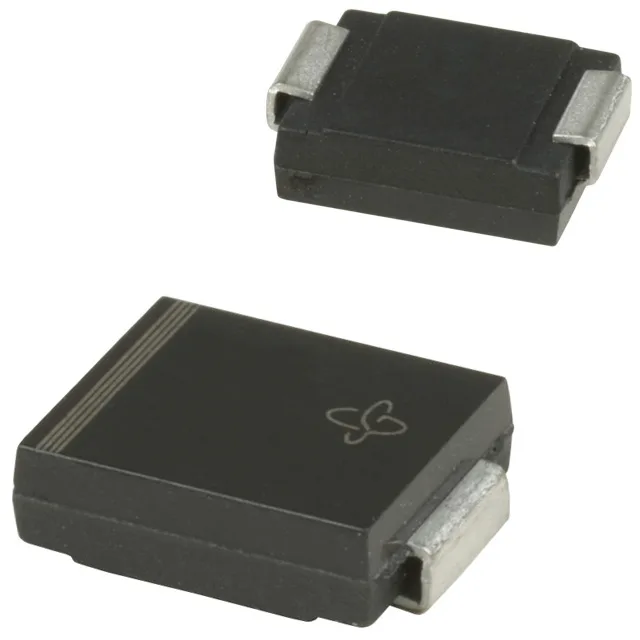
The DO-214AB (SMCJ) package is the industry-standard SMC outline for TVS diodes in this power class. The supplier device package field maps it to SMCJ, confirming footprint and pinout compatibility with any SMCJ TVS from any manufacturer at this voltage and polarity. Surface-mount termination on the DO-214AB demands a reflow profile consistent with MSL sensitivity — the reel packaging in means the part arrives on a moisture-barrier reel; verify the moisture sensitivity level in the datasheet before reflow if the part has been stored open for more than the floor life limit.
Bidirectional polarity and standoff margin
The CA suffix denotes bidirectional polarity — it clamps both positive and negative transients. The 77.8 V standoff applies in both directions, meaning this part suits AC signal rails or bipolar bus protection where neither polarity can exceed the breakdown threshold without clamping. For a unidirectional option that clamps only one polarity with a slightly higher standoff for the same breakdown band, the A-suffix variant (no C) is the direct replacement within the same series.