1500W peak pulse — what that means in the circuit
The 1.5SMC91AHM3/I: That rating determines how large a transient it can absorb before the clamping voltage climbs past the protected load's abs-max. For a telecom line card or an automotive ECU input that must survive ISO 7637-2 pulses, the 10/1000 µs character is the relevant test wave — it sits between the fast capacitive-discharge events and the slow load-dump events found in vehicle electrical systems.
The three-voltage operating envelope
Reverse standoff is 77.8 V typ — the diode sits in high impedance below this and the protected rail runs clean. Those three numbers — 77.8 V standoff, 86.5 V breakdown, 125 V clamping — define the protection window and must bracket the protected device's abs-max rating with margin.
AEC-Q101 qualification and the automotive temperature envelope
Junction temperature limit is 150 °C; the -65 °C cold start capability covers cold-crank and arctic-environment operation. The listed operating temperature is referenced to the junction, not the ambient, so the board-level thermal design must keep the case temperature below whatever derating the application demands.
DO-214AB SMC package and SMT assembly
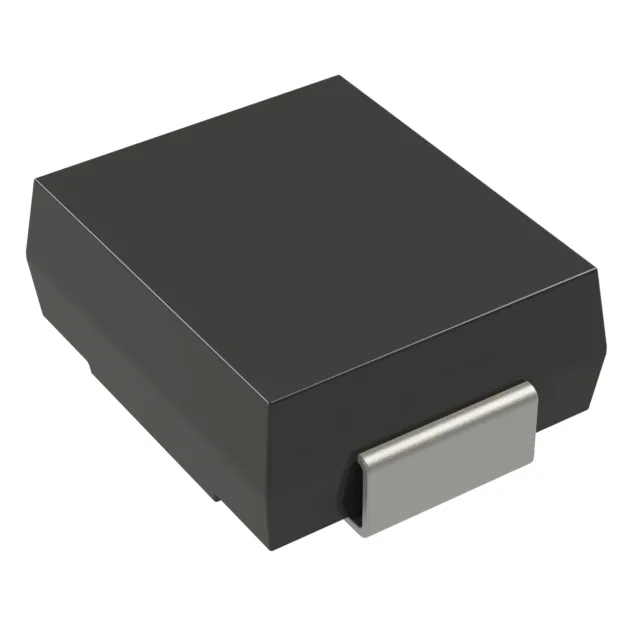
Surface-mount DO-214AB (SMC) package ships on Tape & Reel. The footprint is the industry-standard SMC pad set — the cathodic tab on the top side is the polarity marker. For wave-solder assembly the thermal profile must respect the package's reflow limits; the DO-214AB is not a hermetic ceramic, so prolonged high-temperature exposure affects the die attach rather than the leadframe, but the datasheet profile covers standard SnPb and Pb-free assemblies.