What the clamping ratings mean for automotive protection
The 1.5SMC91AHE3/57T: The 77.8 V reverse standoff is the working rail the TVS sees uninterrupted — the diode stays off and draws only leakage current until a transient pushes it into avalanche. For a 12 V automotive rail, 77.8 V standoff gives plenty of margin against normal operation while clamping inductive load dumps and ESD events to a survivable level.
1500 W peak pulse — sizing for real-world transients
The 12 A peak pulse current rating at that same waveform ties directly to the clamping ceiling: at 12 A the voltage across the diode is held at or below 125 V. If the transient delivers more current, the diode may survive briefly above rating but the clamping voltage will exceed 125 V, so the downstream circuit's transient-withstand margin must be checked independently.
AEC-Q101 grade and junction temperature range
Qualified to AEC-Q101 for automotive deployment — the stress testing covers temperature cycling, humidity bias, and surge life that commercial TVS diodes skip. For a chassis-mounted ECU that sees -40 °C startup, the 150 °C Tj ceiling still leaves headroom after the clamping event raises die temperature above ambient.
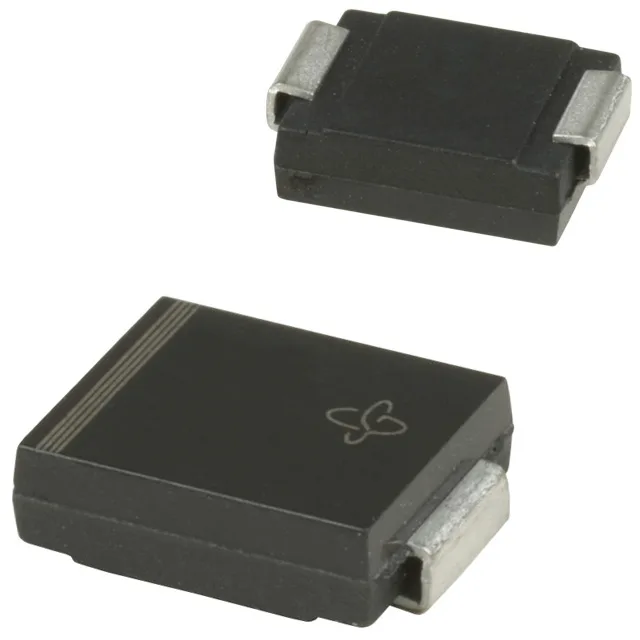
DO-214AB SMC package and automotive board assembly
The DO-214AB (SMCJ) package is the standard form factor for 1500 W TVS diodes — the foot pattern accepts reflow profiles up to the peak temperature the automotive qualification mandates. Tape-and-reel packaging suits high-volume pick-and-place assembly. The unidirectional single-channel topology means the cathode connects to the rail to be protected; the anode goes to ground.