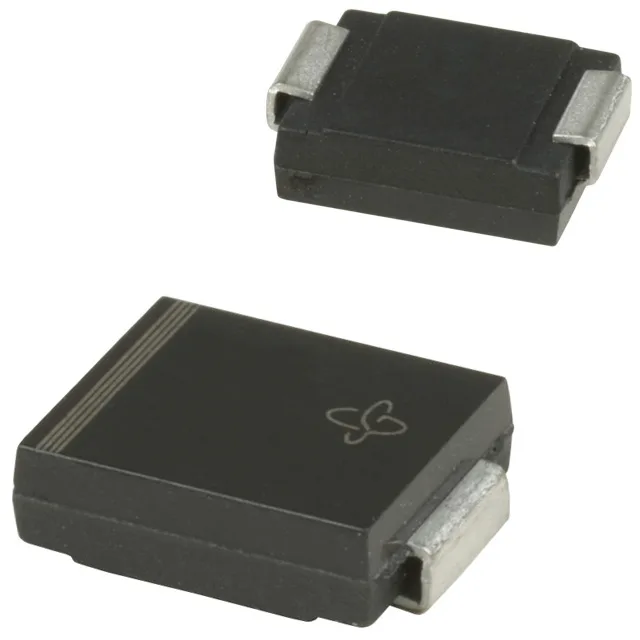
What the clamping and standoff ratings mean for the protection window
The 1.5SMC91A-M3/9AT: The 1.5SMC91A is a unidirectional TransZorb TVS in the DO-214AB SMC package, which means it clamps the protected node at 125 V maximum when a surge arrives, while allowing normal circuit operation up to the 77.8 V reverse standoff — this 47 V gap is the protection window the designer works within. At 77.8 V standoff the device sits below its 86.5 V minimum breakdown threshold and draws only leakage current; once a transient exceeds that threshold the Zener avalanche kicks in and the clamping characteristic holds the node within the 125 V ceiling even as the peak pulse current reaches 12 A.
The 1.5 kW peak pulse rating is specified at a 10/1000 µs wave shape — the 10 µs rise time and 1000 µs fall time model a Lightning impulse or inductive kick event; faster transients (ESD, < 1 µs) will produce higher instantaneous peaks that the same energy budget handles differently, so matching the test waveform to your actual threat profile is the critical selection step.
Junction temperature and board-level integration
Rated for -65 to 150 °C junction temperature, the 1.5SMC91A is suited for harsh-environment deployments where the board-level thermal margin matters — a surface-mount DO-214AB sits on a copper pad sized to keep the case temperature below whatever derating curve the application's ambient demands.
Where a unidirectional TVS in this voltage class fits
General-purpose TVS diodes at this voltage and power class protect sensitive electronics on power rails, signal lines, and communications interfaces in industrial and instrumentation equipment — the unidirectional topology is the right choice when the protected node sees only one polarity during normal operation, which covers the majority of DC power bus applications.