What the clamping spec means for your rail
The 1.5SMC91A-E3/9AT: The 125 V clamping voltage at 12 A peak pulse (10/1000 µs) is the number that decides whether the downstream circuit survives the surge — the standoff of 77.8 V sets the working rail it watches without clipping during normal operation, and the 1500 W peak-pulse rating tells you the energy it can absorb in that event before the Zener regime takes over. For a 77 V rail with a 1.5 kV surge injection, the diode clamps at 125 V and the 12 A peak current flows through the TVS rather than the protected rail.
Unidirectional, single-channel — polarity matters on the board
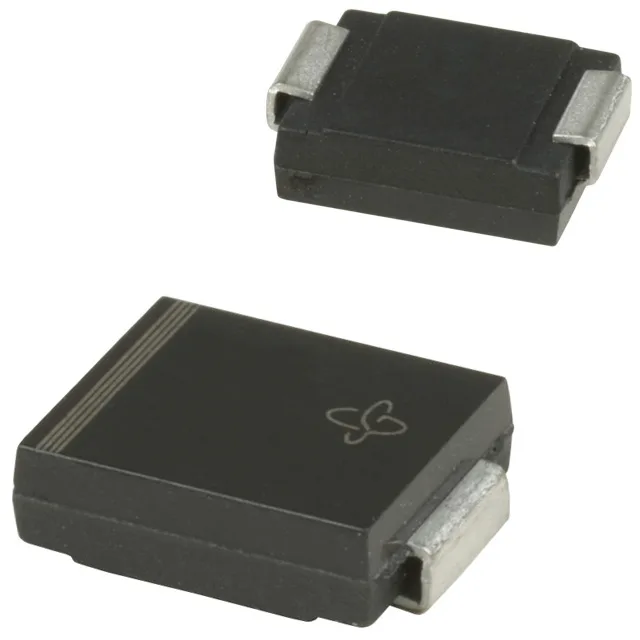
One unidirectional channel means the TVS clamps only transients of one polarity — on a positive-going supply rail the cathode connects to the protected node and the anode to ground. The DO-214AB (SMC) footprint is a standard surface-mount land pattern; the tape-and-reel packaging suits high-volume placement on an automated line.
Wide junction temperature and what it signals about storage
The wide TJ range does indicate the die and epoxy system are qualified for elevated-ambient environments, but the storage floor life comes from the MSL rating not present in this listing.
That makes it a stable BOM line: the part is not going NRND on you without warning, and there is no official last-time-buy window to chase.