What the protection window means
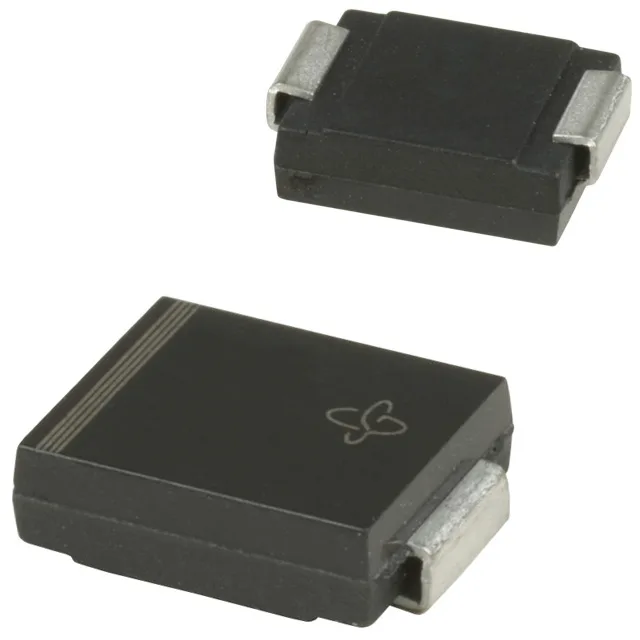
The 1.5SMC9.1CAHM3_A/H: The 7.78 V reverse standoff is the working voltage of the rail this part is placed across — the TVS stays reverse-biased and invisible in normal operation. When a transient exceeds the standoff, it avalanches at the 8.65 V minimum breakdown and clamps the peak at 13.4 V, limiting what reaches the downstream load. The difference between the two — roughly 4.55 V at the clamping ceiling — is the protection margin the downstream circuitry must survive. The 1.5 kW rating is the peak-pulse power envelope at that waveform — the part is designed for infrequent, high-energy events rather than continuous dissipation, so repeated transients above the repetitive peak pulse rating will accumulate degradation.
Automotive-qualified transient protection
For a TVS protecting an ECU input or a telecom line card, that qualification is the gate: a commercial-grade Zener TVS in the same package may share the footprint but has not been screened to the same failure-mode profile under automotive thermal and humidity conditions. Junction temperature is what matters here: the thermal resistance from junction to ambient through the board footprint determines whether the clamping event keeps the TJ below 150°C at the operating ambient.