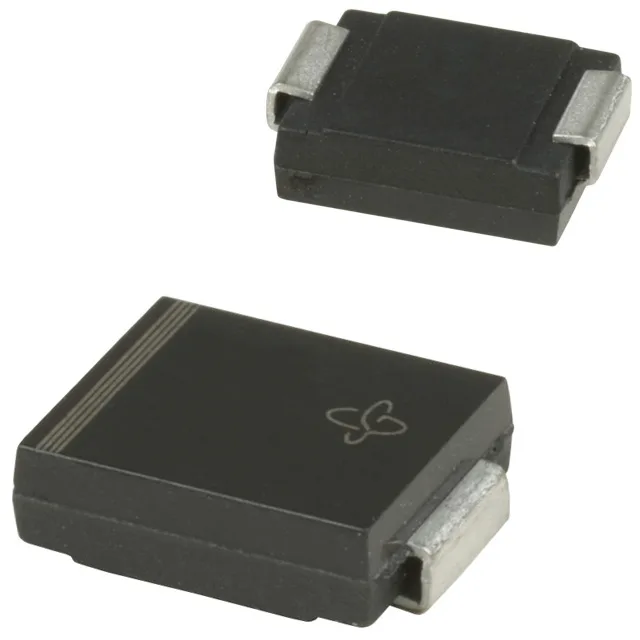
Vishay General Semiconductor - Diodes Division 1.5SMC9.1CAHE3_A/H — Circuit Protection

Vishay 1.5SMC9.1CAHE3_A/H TVS Diode, 7.78V Standoff

MPN1.5SMC9.1CAHE3_A/H
Active

Vishay General Semiconductor - Diodes Division 1.5SMC, TransZorb® Zener TVS diode, automotive grade, AEC-Q101, 1500W peak pulse, 112A at 10/1000µs, 7.78V standoff / 13.4V clamp, DO-214AB surface mount, tape & reel.

Independent supplier — new & surplus stockAuthenticity-screened · ESD-safe packingListing updated Aug 2026

Specifications

1.5SMC9.1CAHE3_A/H specifications
ParameterValue
TypeZener
Series1.5SMC, TransZorb®
MountingSurface Mount
Voltage - breakdown8.65V
Voltage - clamping (Max) @ ipp13.4V
Voltage - reverse standoff7.78V
Current - peak pulse (10/1000μs)112A
Power - peak pulse1500W (1.5kW)
Power line protectionNo
Operating temperature-65°C ~ 150°C (TJ)
GradeAutomotive
PackageTape & Reel (TR)
QualificationAEC-Q101
CaseDO-214AB, SMC
Bidirectional channels1

Product details

Clamping window — what the standoff and breakdown voltages mean for the protected rail

The 1.5SMC9.1CAHE3_A/H: The reverse standoff of 7.78 V typ sets the maximum working voltage the protected rail sees during normal operation — the TVS stays reverse-biased and off until a surge arrives.

Automotive qualification — AEC-Q101 and the under-hood thermal envelope

AEC-Q101 is the automotive discrete semiconductor stress qualification — it certifies the part has passed temperature cycling, humidity bias, power cycling, and surge-life testing at the grade 1 temperature band (-40 to +125 °C ambient). For a TVS protecting an ECU input or a sensor rail, this means the clamping path itself is rated for the thermal profile of a sealed engine-compartment module without derating to a lower current grade. Junction temperature range is -65 to +150 °C — the upper limit gives headroom above the 125 °C grade 1 ceiling, so a 105 °C under-hood ambient still leaves 45 °C of junction rise margin at typical surge duty.

Sourcing posture — active, no successor on record

Available through independent distribution and quoted to order against BOM quantity with full lot traceability and manufacturer warranty from an authorized source.

Frequently asked questions

What is the difference between the standoff voltage and the clamping voltage on a TVS diode like 1.5SMC9.1CAHE3_A/H?

The standoff voltage (7.78 V typ) is the maximum normal working voltage the protected rail runs at — the TVS sits reverse-biased and idle in normal operation. The clamping voltage (13.4 V max) is what the line is clamped to when a transient exceeds the breakdown threshold (8.65 V min), carrying up to 112 A peak pulse. The protection window between standoff and clamping is therefore roughly 5.6 V of headroom before the TVS activates.

What does AEC-Q101 mean for selecting 1.5SMC9.1CAHE3_A/H in an automotive design?

AEC-Q101 qualification means the device has passed the automotive discrete semiconductor stress matrix — it is approved for automotive electronics under the hood, in the cabin, or in chassis domains, as opposed to a commercial-grade TVS which is only rated for benign environments. This qualification is a prerequisite for safety-critical or reliability-class automotive ECUs, and many tier-1 automotive customers will not accept a part without it on the BOM line.