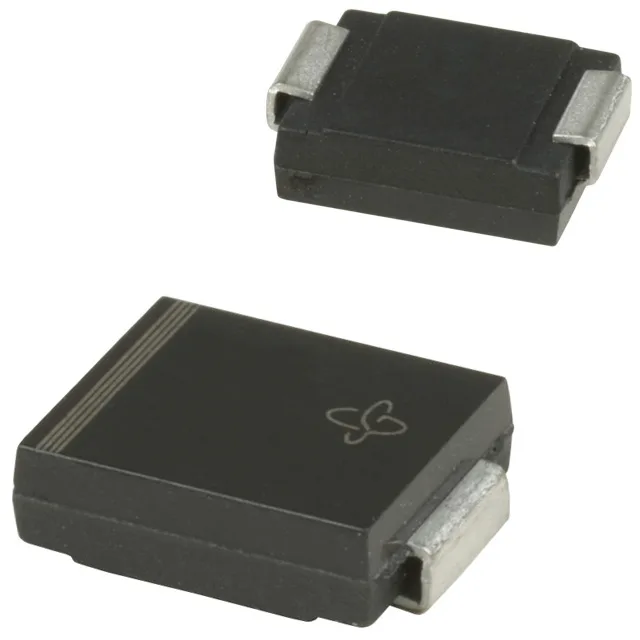
Vishay General Semiconductor - Diodes Division 1.5SMC9.1CAHE3/9AT — Circuit Protection

Vishay 1.5SMC9.1CAHE3/9AT TVS Diode, 13.4V Clamp, 1.5kW Peak

MPN1.5SMC9.1CAHE3/9AT
Active

Vishay General Semiconductor - Diodes Division 1.5SMC9.1CAHE3/9AT, automotive bidirectional TVS Zener, 7.78 V standoff, 8.65 V min breakdown, 13.4 V clamping @ 112 A, 1.5 kW peak pulse, DO-214AB (SMC) surface mount.

Independent supplier — new & surplus stockAuthenticity-screened · ESD-safe packingListing updated Aug 2026

Specifications

1.5SMC9.1CAHE3/9AT specifications
ParameterValue
TypeZener
SeriesAutomotive, AEC-Q101, 1.5SMC, TransZorb®
MountingSurface Mount
Voltage - breakdown8.65V
Voltage - clamping (Max) @ ipp13.4V
Voltage - reverse standoff7.78V
Current - peak pulse (10/1000μs)112A
Power - peak pulse1500W (1.5kW)
Power line protectionNo
Operating temperature-65°C~150°C(TJ)
PackageTape & Reel (TR)
ApplicationsAutomotive
CaseDO-214AB, SMC
Bidirectional channels1

Product details

The 1.5SMC9.1CAHE3/9AT: At the clamping voltage of 13.4 V, the part clamps the spike before the downstream circuit sees it, and the 112 A peak pulse current at that clamping point confirms the absorption capacity the clamping stage must deliver. For a 12 V automotive rail, a 13.4 V clamp gives adequate headroom above the nominal supply while keeping let-through voltage below what most downstream ICs tolerate.

Voltage stack — standoff, breakdown, and clamping

The reverse standoff of 7.78 V defines the maximum voltage the protected node sits at during normal operation — below this the TVS leaks minimally and the protected rail sees no clamp action. Breakdown starts at 8.65 V minimum; once the transient pushes the node into this band the TVS begins conducting and redirects the surge energy.

Automotive qualification and thermal range

AEC-Q101 qualified, part of the TransZorb® series in the 1.5SMC automotive family. Junction temperature range is -65°C to 150°C, which covers the under-hood band — engine-bay ambient that peaks near 125°C in summer still leaves margin before the 150°C TJ ceiling. The qualification stress testing covers temperature cycling, humidity, and mechanical shock, so the DO-214AB package is field-replaceable on an automotive board without special handling concerns.

DO-214AB (SMC) package with the matching SMCJ supplier device designation — standard metal-electrode pad footprint on the cathode side. Surface-mount reflow profile; the cathode stripe marking is the orientation reference. For automotive boards requiring hand-rework, the SMCJ form factor is accessible with a fine-tip iron and drag-solder technique, though hot-air is cleaner. No exposed paddle; thermal relief on the pad lands manages solder fillet geometry during assembly.

Frequently asked questions

What voltages define the protection window for 1.5SMC9.1CAHE3/9AT?

The protection window runs from 7.78 V reverse standoff — below this the TVS leaks minimally and the protected node operates normally — up to the 8.65 V minimum breakdown, where the TVS begins conducting and clamps the transient.

What is the 1.5SMC9.1CAHE3/9AT used for?

It is a unidirectional (bidirectional) TVS Zener designed for automotive circuit protection on 12 V rails. The 7.78 V standoff fits a 12 V nominal system with adequate margin; the 1.5 kW peak pulse rating handles the ISO 7637-2 load-dump and jump-start transients common in automotive environments. AEC-Q101 qualification is the qualification standard for automotive-grade discrete semiconductors, covering temperature cycling, humidity bias, and mechanical stress.