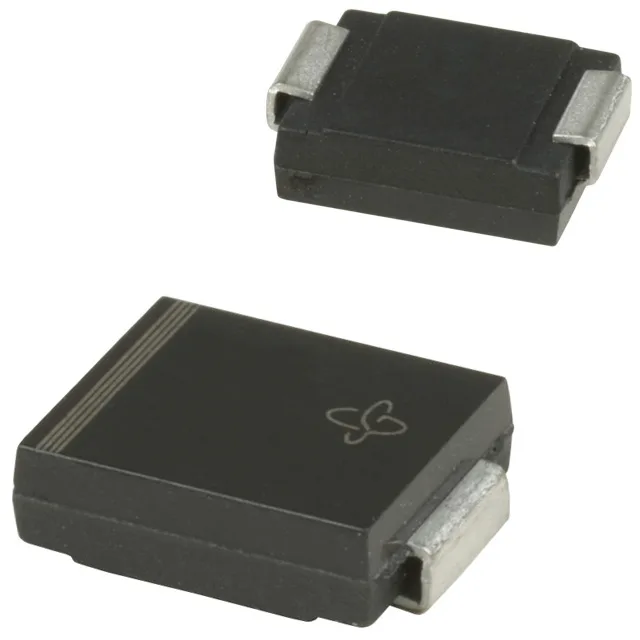
Peak pulse power — what 1.5 kW means in the protection circuit
The 1.5SMC9.1CA-E3/57T: The 1500 W peak pulse rating (10/1000 µs waveform) is the ceiling this part sets for absorbed transient energy — it defines the largest surge the clamping path can survive without degradation or failure. The 112 A peak pulse current rating is the other half of that ceiling: at the clamping voltage of 13.4 V, the device conducts up to 112 A for the standard 10/1000 µs event, and the two specs together confirm the protection envelope for the downstream node.
Standoff, breakdown, and clamping — the three-voltage protection sequence
The reverse standoff voltage of 7.78 V is the bias the circuit sees during normal operation — it sits below the breakdown threshold, so the diode presents a high impedance and draws only leakage current. The separation between standoff (7.78 V) and clamping (13.4 V) defines the protection headroom — the downstream component must survive a short-duration overvoltage spike of 13.4 V for the event to be safely absorbed. Power line protection is listed as No — this part is not characterized for dedicated AC power-line suppression. It suits node-level or signal-line protection in DC circuits, where the 8.65 V breakdown and 7.78 V standoff are appropriate for 5 V or low-voltage rail protection.
Bidirectional clamping and thermal margin
A single bidirectional channel means it clamps both polarities — useful for data lines, RF paths, or any node that sees symmetric transients without requiring two unidirectional devices.
Where the 1.5SMC family is deployed
The 1.5SMC TransZorb® series is a general-purpose unidirectional/bidirectional TVS family used across industrial control, communications, and consumer electronics to protect sensitive nodes from electrostatic discharge and inductive switching transients. The DO-214AB (SMC) J-lead package is a standard surface-mount outline compatible with automated assembly workflows; the listing confirms both Tape & Reel and Cut Tape packaging options to support production quantities and prototype runs respectively.