TransZorb protection — what the clamping spec means
The 1.5SMC9.1AHM3/H is an automotive-qualified unidirectional Zener/TransZorb TVS in the 1.5SMC series — Vishay's registered trademark for the peak pulse clamping structure inside the package. The standoff voltage sits at 7.78 V typical, meaning the TVS stays invisible to the line during normal operation and turns on hard only when a surge appears. Minimum breakdown of 8.65 V gives the Zener knee a defined start — for a 9.1 V nominal part the spread between standoff and breakdown is tight, which is intentional: it keeps the clamping margin appropriate for 12 V rail protection without eating into the protected side's operating window.
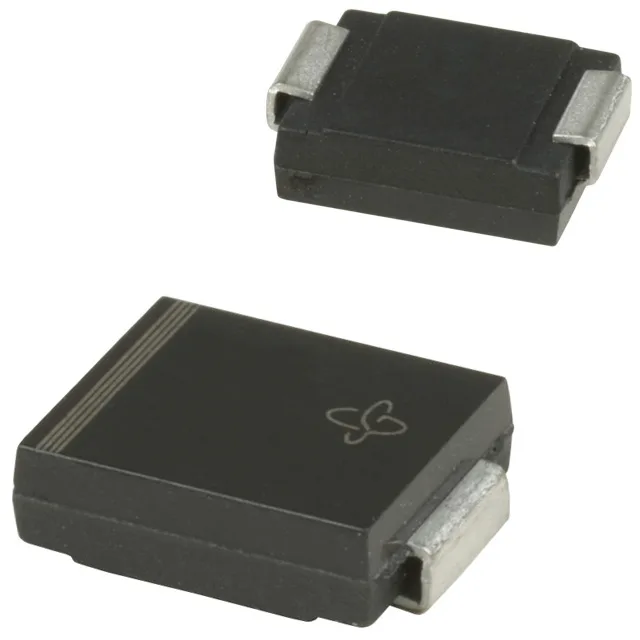
DO-214AB SMC package — what it connects to
The DO-214AB (SMC) is a non-isolated surface-mount package — the cathode tab is the die attach and thermal path. In a protection design the anode lands to the reference plane (typically chassis or signal ground) and the cathode connects to the line being guarded. The thermal interface between the cathode pad and the PCB copper under the part governs the junction temperature under surge — the rated 1500 W peak pulse assumes an appropriate land pattern, not the bare pad alone. Tape-and-reel packaging (TR) is standard for high-volume pick-and-place assembly; the AEC-Q101 grade does not require any special MSL handling beyond the standard floor-life limit for the package — check the MSL rating before assembly if the part has been stored long-term.
Automotive qualification — what AEC-Q101 means here
The Tj rating of -65 °C to 150 °C spans the full automotive temperature band — cold start, engine bay adjacent, and thermal soak are all within the operating envelope. AEC-Q101 is the automotive council's stress-test qualification for discrete semiconductors: it means the part passed temperature cycling, humidity bias, and surge life testing at the wafer level, making it deployable in safety-critical and powertrain-adjacent protection circuits without a separate qualification program. The listed applications are Automotive and Telecom — the 1.5SMC series is one of the workhorse families for 12 V and 24 V rail transient protection in both domains. The distinction matters for the protection design: automotive edge rates and surge profiles follow ISO 7637; telecom follow GR-1089. The part survives either if the clamping energy fits within the 1500 W rating.