What the clamping stack means for the protected rail
The 1.5SMC9.1AHE3/9AT: The part sits at 7.78 V reverse standoff — the rail it guards sees normal operation uninterrupted below that level. When a transient exceeds the 8.65 V breakdown minimum, the TVS clamps the peak at 13.4 V while conducting 112 A of surge current. For an under-hood ECU that runs at 125 °C ambient with self-heating, the 150 °C rating gives roughly a 25 °C margin — enough to absorb a worst-case surge without the junction hitting its temperature ceiling during the clamping event.
AEC-Q101 in the 1.5SMC automotive TVS family
AEC-Q101 qualification means the die and package passed temperature cycling, surge life, humidity, and ESD screening — this is the stress gate for automotive ECUs where a failed TVS lets a transient reach the ASIC behind it. The TransZorb® branding marks Vishay's internal oxide-passivated Zener process, giving repeatable avalanche characteristics across production lots.
DO-214AB SMC footprint and reel packaging
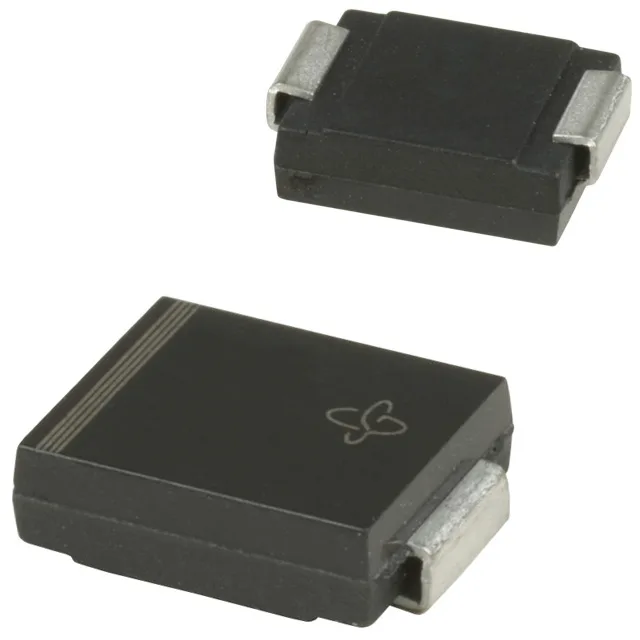
The DO-214AB (SMC) package is the mid-size SMC footprint — larger than the SMA and SMB, giving better thermal pad area for a 1.5 kW part than a smaller body would allow. Supplied on tape-and-reel, compatible with standard SMT pick-and-place — the Supplier Device Package field lists SMCJ which is the industry standard alias for this foot print.
Active lifecycle, single-source and sourcing posture
Listed as Active.