TransZorb TVS — what the standoff and breakdown voltages mean for your protection circuit
The 1.5SMC82CA-M3/9AT is a unidirectional transient voltage suppressor — Vishay calls it a TransZorb, which is a TVS diode with a specific avalanche characteristic, not a standard Zener regulator. The reverse standoff voltage of 70.1 V defines the continuous working voltage the diode can hold off without conduction; the circuit must never bias it above this in normal operation. Breakdown starts at 77.9 V minimum — this is where the TVS snaps into avalanche and begins clamping. The 10/1000 µs shape is the standard IEC 61000-4-5 surge waveform, so the 1.5 kW rating is directly comparable to the test level your end equipment must pass.
Peak pulse capability and what the 1.5 kW figure decides
Peak pulse power of 1500 W (1.5 kW) is the product of clamping voltage and peak pulse current at the stated waveform — it tells you the surge energy the device can absorb without degradation. This is the primary selection parameter for a TVS in a protection chain: the upstream clamp must survive the surge that the downstream load cannot. As ambient approaches the upper end, the clamping voltage characteristic shifts per the datasheet temperature coefficient; for precision over-voltage detection, this shift is a board-level design consideration.
Package, mounting, and application fit
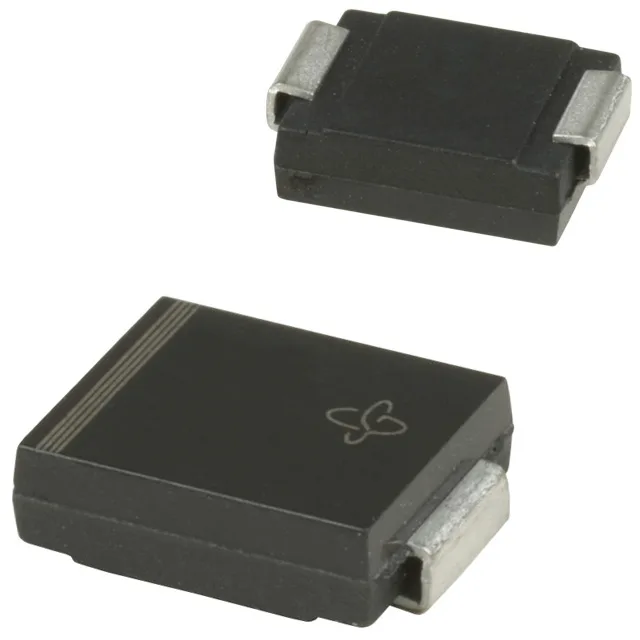
The DO-214AB (SMC) package is the standard surface-mount footprint for 1.5–3 kW TVS diodes — the cathode bar in the center of the package marks the unidirectional polarity. Recommended pad layout matches the anode and cathode pads to the thermal impedance of the die; the SMC's exposed die-attach paddle gives better thermal cycling performance than the smaller SMC variants used below 1 kW. Listed as general-purpose — this covers power-supply input protection, signal-line transient suppression, and industrial control modules where a 70.1 V working voltage suits 48 V nominal rails with adequate margin. Power-line protection is flagged No, meaning it is not rated for direct AC line attachment; use a specific AC-line TVS series for that position. Single bidirectional channel — the CA suffix designates the bidirectional polarity direction across the cathode and anode. Polarity matters: reverse-bias the cathode relative to the anode for normal standby; the TVS fires in the forward direction only if the transient reverses polarity through the protection node.
Carries an Active lifecycle status from Vishay General Semiconductor — production is not flagged for discontinuation or last-time-buy on the current record. No official successor order code appears in the ledger for the 1.5SMC82CA base number. Sourced to order against BOM quantity through independent distribution channels.