1.5 kW peak-pulse rating and clamping architecture
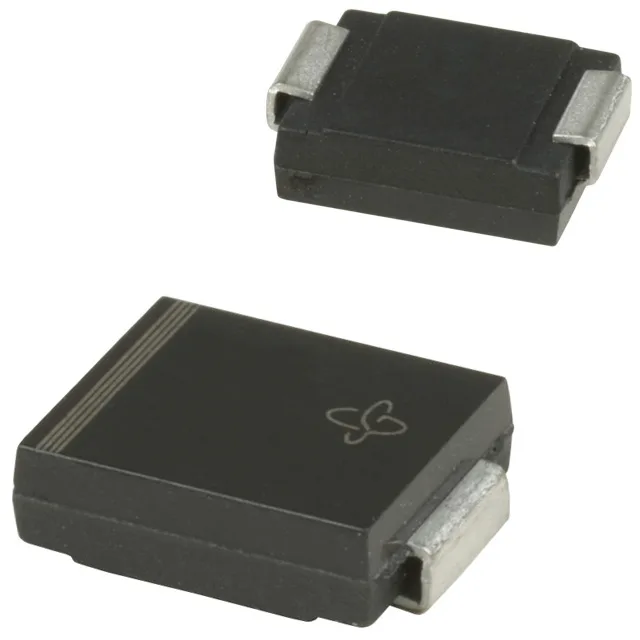
The 1.5SMC82CA-E3/57T: The 1.5SMC82CA-/57T is a bidirectional Zener-based transient voltage suppressor (TVS) — Vishay's TransZorb® series — in the DO-214AB (SMCJ) surface-mount package, rated for 1500 W peak pulse at a 10/1000 µs waveform. The 1.5 kW rating is the surge-handling ceiling: it defines the energy the diode can absorb during a single fast-transient event without degradation, so a design's threat profile (lightning, inductive kick, ESD) must stay below that envelope or a larger package family is required.
Voltage chain — standoff, breakdown, and clamping
Three voltage levels define the protection window. Reverse standoff (typ) is 70.1 V — the working rail the protected circuit sees in normal operation. Minimum breakdown is 77.9 V — the threshold where the TVS begins conducting. The headroom between 113 V and the 77.9 V breakdown is the voltage let-through the downstream circuitry must survive during the event — this is the primary selection trade-off versus the IC or bus being protected.
Thermal margin and junction temperature
The junction operating temperature range is -65 °C to 150 °C — wide enough for most industrial and outdoor environments. The 150 °C TJ ceiling constrains how much of the 1.5 kW rating can be used continuously: the diode absorbs transient energy, not continuous power, so thermal design of the PCB landing and copper pour under the DO-214AB tab governs real-world survival in repeated-surge or elevated-ambient conditions.
Packaging, mounting, and sourcing posture
Supplied in tape-and-reel (TR) and cut-tape (CT) formats; the supplier device package is listed as SMCJ. Lifecycle status is Active with Vishay General Semiconductor — Diodes Division. The base product number 1.5SMC82 confirms the 82 V nominal Zener voltage and CA polarity coding for bidirectional operation. This part is noted as not suited for power line protection applications — it is a board-level clamping device, not a mains-supply TVS.