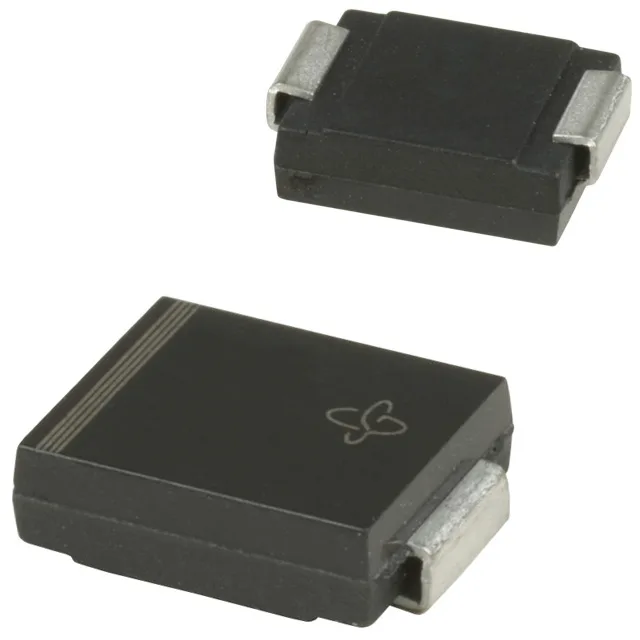
What the 1.5SMC82AHE3/9AT protects
This is a unidirectional TVS diode — a transient voltage suppressor that clamps overvoltage spikes to a safe level before they reach the load, then resets automatically when the event passes. The TransZorb® designation is Vishay's proprietary construction: the die is bonded and wired inside the package cavity, making it a true Zener-based suppressor rather than a simple junction clamp.
The protection envelope — standoff, breakdown, clamping
The reverse standoff voltage of 70.1 V is the working DC rail the protected node can sit at continuously without the TVS conducting — in a 48 V automotive rail the 70.1 V standoff gives 20 V of headroom to the clamping threshold. When a transient pushes the node above the 77.9 V minimum breakdown, the device avalanches into conduction and enters its clamping state — the maximum clamping voltage at the rated peak pulse current of 13.3 A is 113 V. The 113 V clamping ceiling at 13.3 A defines the protection level the downstream IC sees — with a 1.5 kW peak pulse rating, the diode survives a single 10/1000 µs surge event without degradation, and multiple events within the thermal cycling envelope do not shift the breakdown voltage.
AEC-Q101 automotive grade and thermal margin
The 1.5SMC82AHE3/9AT is AEC-Q101 qualified — meaning it has passed the automotive reliability stress tests: humidity, temperature cycling, terminal strength, and surge life. For under-hood ECUs that see -40 °C cold-soak and junction temperatures up to 150 °C, the 150 °C maximum junction rating is the relevant thermal ceiling. Tape-and-reel packaging is standard for automotive production flow — the 1.5SMC82AHE3/9AT ships on the base product number 1.5SMC82, with the /9AT suffix coding the automotive grade and terminal finish.