What the clamping ratings mean for your circuit
The 1.5SMC82A-M3/9AT: The 77.9 V minimum breakdown confirms the diode activates in the TVS region rather than creeping on at normal operating voltage. At the peak pulse condition of 13.3 A (10/1000 µs wave shape), the clamping voltage is held to 113 V maximum — that 113 V ceiling is what the downstream circuitry must survive. Peak pulse power handling is 1.5 kW, which is the product of that clamping voltage and the peak current, so the part is sized for the 10/1000 µs surge class common in industrial and power-supply environments rather than the faster 8/20 µs waveform. The unidirectional configuration clips positive transients only — if the protected line can see negative spikes (common on inductive kickoff), a complementary bidirectional part or a separate reverse-polarity clamp is needed on the negative side.
Thermal margin and the wide junction temperature range
For a TVS that absorbs surge energy as heat, the derating curve in the Vishay datasheet governs how much of the 1.5 kW rating survives at elevated ambient — always run that check at the worst-case enclosure temperature before locking in the thermal layout.
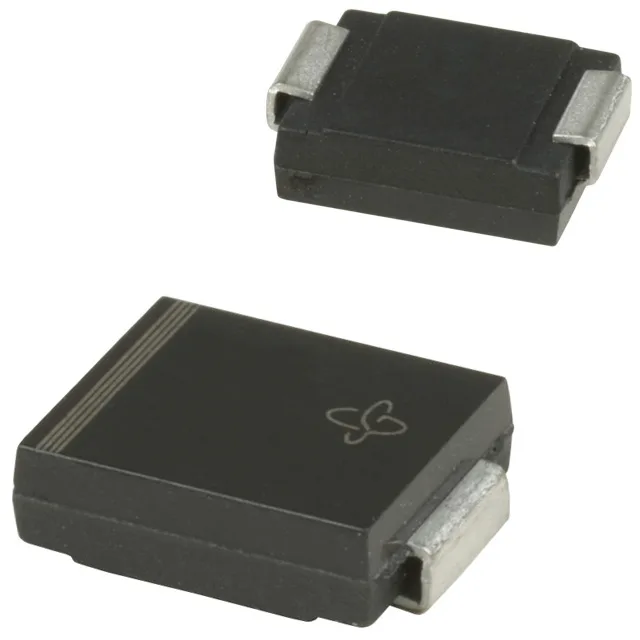
DO-214AB SMC package and rework reality
The SMC (DO-214AB) package is a two-terminal EIA-style outline — cathode band marking identifies pin 1 on the Zener-oriented part, so orientation under hot air is unambiguous. The wide cathode pad gives a decent thermal path for the 13.3 A peak pulse current during a surge event, but the diode dissipates that energy as heat into the board copper, not through the package top. Layout rule of thumb: keep the cathode pad and surrounding copper generous — a thin pad starves the clamping performance under a real surge. As a surface-mount part on tape and reel, it fits the standard pick-and-place flow. The DO-214AB footprint is widely supported in almost every TVS family, so swapping to a second-source or a tighter/higher clamping variant is usually a layout-compatible change.
What the 1.5SMC family is built for
The 1.5SMC TransZorb series targets secondary-side protection in power-supply rails, DC bus clamping, and signal-line surge suppression — general-purpose means it is not qualified to any automotive or IEC 61800 immunity profile by default. If the target application requires compliance to a specific standard (such as IEC 61000-4-5 surge), the datasheet immunity curves need to be reviewed against the system's required test level.