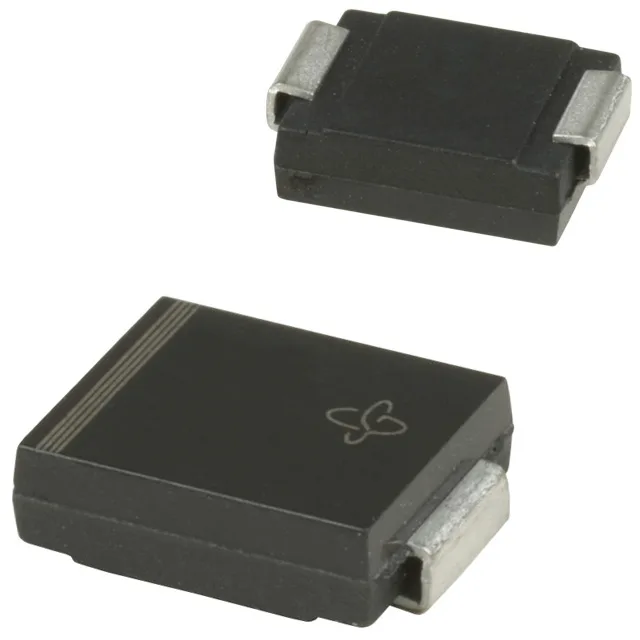
What the clamping voltage means for board-level transient suppression
The 1.5SMC82A-E3/57T: The 70.1V reverse standoff and 113V clamping at 13.3A peak pulse define the TVS zone — a transient that tries to push the line above 70.1V is clamped to 113V before it reaches the protected node. For a 70V rail this means roughly a 1.7× safety margin, which is tight compared to wider-margin TVS choices — check that the downstream semiconductor abs-max rating survives a 113V clamped event at the source impedance of the line.
Junction temperature range signals where this part lives
A junction derated to 125°C under a worst-case 85°C ambient leaves 25°C of headroom at nominal clamping duty — acceptable for intermittent transients but not for a TVS that clamps continuously. If the protected rail runs near its max most of the time, a higher-standby part with more headroom is worth the cost delta. The DO-214AB (SMCJ) package (/) shares the same footprint as the SMA and SMB families — board layout for a SMCJ lands the same pads as an SMB and uses more copper plane than a SMA for thermal relief on the tab.