What the clamping voltage and peak pulse current mean for your circuit
The 7.02V typical reverse standoff voltage sets the normal operating window; the 7.79V minimum breakdown voltage is the point where the TVS begins to conduct. With 124A peak pulse capability and 1500W peak pulse power ratings, the 1.5SMC8.2CAHM3_A/I absorbs the surge energy without cascading a fault upstream — critical in automotive and telecom power rails where the load is sensitive to transient overvoltage.
Junction temperature range and automotive qualification
The 150°C TJ ceiling gives thermal headroom above the typical 125°C ambient limit in engine-compartment applications. AEC-Q101 qualification means the device has passed the automotive reliability stress battery — temperature cycling, humidity,ESD human-body model, and mechanical shock — making it eligible for safety-critical chassis and powertrain circuits where non-automotive TVS diodes would not be accepted.
TransZorb construction and the single-channel bidirectional configuration
TransZorb is Vishay's junction design for TVS behaviour — it handles the asymmetrical surge event better than a plain Zener, clamping in the reverse direction while the Zener mechanism handles the forward conduction. The single bidirectional channel means it protects a single rail; power line protection is listed as No, confirming it is a rail-level clamp rather than a bus protector.
DO-214AB SMC surface-mount footprint and Tape & Reel packaging
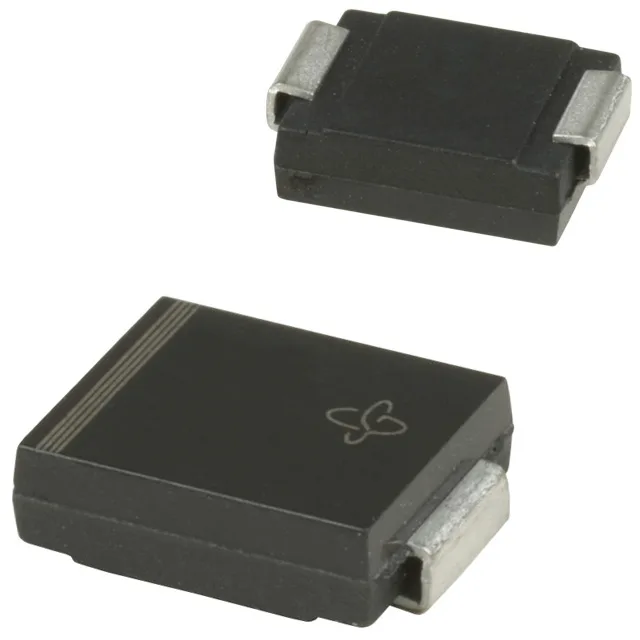
The DO-214AB (SMC) package is the industry-standard TVS footprint — the wide cathode tab provides a thermal path to the PCB pad, and the 3.95mm body width fits standard solder-mask openings on most automotive and telecom board layouts. Supplied on Tape & Reel for high-volume pick-and-place assembly.