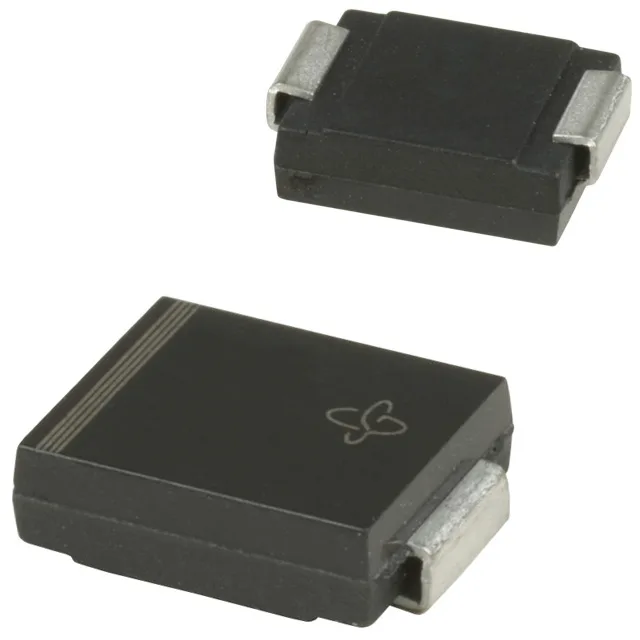
What the 1.5kW clamp rating means for board-level protection
The 1.5SMC8.2CAHM3/H: This waveform shape is the automotive load-dump standard: a slow, high-energy surge that a 1500W part absorbs and clamps without going into thermal runaway. Working reverse standoff sits at 7.02V: the line floats below this in normal operation, and the TVS presents high impedance — it sits dormant on the net until a surge pushes it above breakdown. Minimum breakdown is 7.79V, so there is a small symmetric window around 7.02V where the part is not yet protecting — a design that sits close to the standoff on a regular basis is using the wrong clamping class. If the board sees ESD-level events (IEC 61000-4-2, sub-nanosecond), a 1.5kW TVS may not respond fast enough to protect — that circuit needs a dedicated ESD clamp ahead of the TVS.
AEC-Q101 grade and the HM3 automotive suffix
The CA designation in the order code confirms unidirectional (bidirectional would read CAX); the HM3/H suffix flags the automotive manufacturing flow — this is the Vishay AEC-Q101 qualified grade in the 1.5SMC series. AEC-Q101 qualification means the die and package have passed temperature cycling, humidity bias, and surge life testing to the automotive stress standard — relevant if the end equipment goes into an engine-compartment or chassis domain where -65 to +150°C junction temperature is the actual operational band. Automotive and telecom are the listed applications — a 7.02V standoff TVS on a 12V automotive rail (nominal, with 14V charging) sits with enough headroom to survive the working voltage and enough speed to clamp the load-dump spike. On telecom, the same standoff fits 5V and 12V bus protection. Confirm the 7.02V standoff is above the line's maximum working voltage with margin — a 7.02V TVS on a 6.6V telecom rail with ringing above 8V will be in partial conduction continuously, and the 1500W rating is an event spec, not a DC rating.
DO-214AB SMC footprint and reel packing
Tape and reel packaging means MSL handling applies: confirm the incoming floor accepts the reel, whether dry storage is required for the assembly bake budget, and check the date code on the reel label against the assembly floor's shelf-life policy before loading the feeder. No power-line-protection flag means this part is not a service-entrance surge protective device — it is a board-level component protecting an individual net. Do not specify it as the sole protection at a DC power input feeding multiple board-level loads without a coordination study; the 1500W rating is per-event and the clamping voltage must be below the most sensitive downstream IC absolute maximum.