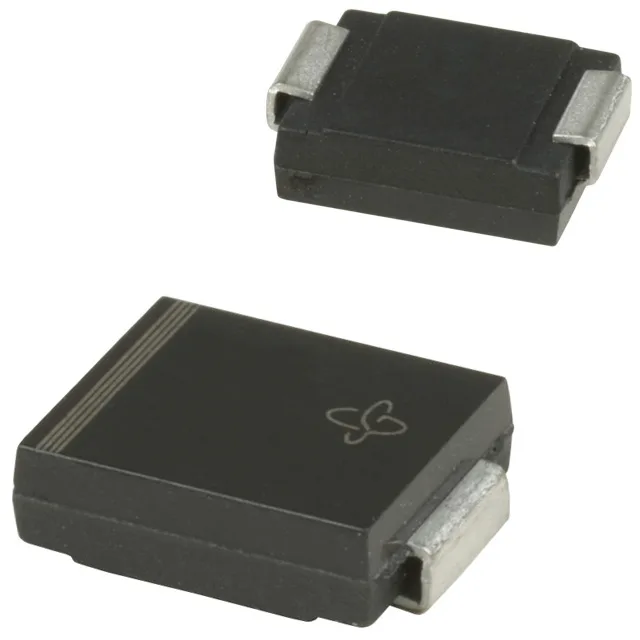
The 1.5SMC8.2CAHE3/9AT: That number is what you match against the prospective short-circuit current of the protected rail, not the headline 1.5 kW figure, which is the product of clamping voltage and peak current under the standard 8/20 µs or 10/1000 µs surge waveform. The 7.79 V minimum breakdown voltage is where the clamping stage activates — once the transient pushes the protected rail above this threshold, the TVS zeners into conduction and clamps the overvoltage to 12.1 V, protecting whatever downstream IC sits behind it. The 7.02 V reverse standoff during normal operation means the diode presents a high-impedance leak path at the nominal rail voltage, drawing only its reverse leakage current.
AEC-Q101 automotive grade and the 150 °C junction ceiling
The AEC-Q101 qualification adds the automotive-specific reliability stress screening that distinguishes a true automotive-grade TVS from the commercial series, which matters for safety-critical and powertrain protection circuits where the diode is the last line of defence before an ECU or sensor module. No PCN or LTB notice appears in the available record, so it remains a stable BOM line for new and existing automotive designs.
DO-214AB SMC package and SMT assembly
The DO-214AB (SMC) package is the standard automotive TVS footprint at this power class — the wide cathode tab under the body carries heat to the PCB pad, and the 3.95 mm x 2.6 mm outline fits the standard SMC land pattern without special keep-out. The tape-and-reel packing option is the standard delivery format for high-volume SMT assembly lines, with the reel diameter and tape width confirming compatibility with standard pick-and-place tooling. The base product number 1.5SMC8.2 ties the HE3/9AT suffix to the standard voltage variant — the suffix encodes the grade, termination finish and pack format within the same mechanical outline, so a board designed for a standard SMC TVS at this voltage point can accept this part without layout revision.