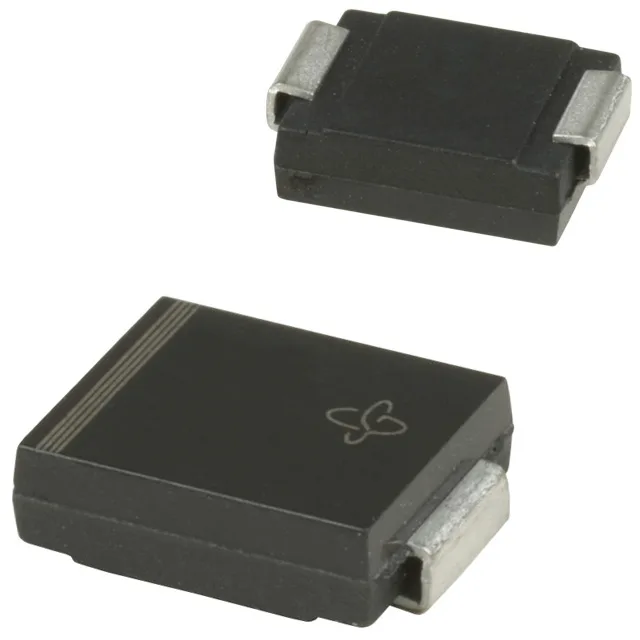
Peak pulse handling — the 1500W rating
The 1.5SMC8.2CA-E3/9AT: That 124A is the clamping current the device can absorb at the 12.1V clamping ceiling without degradation; in practice the downstream load sees that clamped voltage, not the raw transient. A 124A event at 12.1V represents roughly 1.5 kJ of energy in a 1 ms pulse — the kind of spike that kills gate oxides and latch-up destroys bus receivers if not clamped fast. The 1500W figure is the product family's thermal reference, not a continuous rating.
Standoff, breakdown, clamping — the voltage stack
The standoff voltage is 7.02V typical — the device sits idle below this in normal operation, drawing only leakage current. Breakdown occurs at 7.79V minimum; the clamping voltage ceiling is 12.1V at rated peak current. That means the device transitions from off-state to conduction over a window of less than 5V, clamping at 12.1V — a 55% over-breakdown ratio. For a board protecting a 5V rail, that 12.1V ceiling sits above the rail but well below what most CMOS input stages tolerate as a damage threshold.
Harsh-environment temperature rating
The 150°C ceiling gives margin for the thermal rise during a clamp event — the clamping voltage will track upward with junction temperature, so the 12.1V spec is the 25°C baseline. DO-214AB (SMC) package is the standard surface-mount form factor for this power class, accepting standard reflow profiles and compatible with standard copper pad layouts for the series.