TVS clamping and standoff ratings — what the numbers mean for protection design
The 1.5SMC8.2CA-E3/57T: When a transient fires, the breakdown threshold sits at 7.79 V minimum, and the clamping voltage at peak pulse current reaches 12.1 V maximum — the downstream circuit sees that 12.1 V ceiling, not the full surge voltage, so the downstream IC or rail must survive a 12.1 V clamp event at 124 A peak pulse (10/1000 µs waveform).
Peak pulse power — the 1.5 kW figure and what it protects
At 124 A peak pulse current the clamping action is short-duration and high-energy — the diode absorbs the surge energy and dissipates it as heat. The 150 °C maximum junction temperature gives the thermal designer the headroom to verify the clamping event stays within the transient thermal impedance curve, particularly on a surface-mount pad where the PCB copper acts as the heatsink.
Package and junction temperature for board-level layout
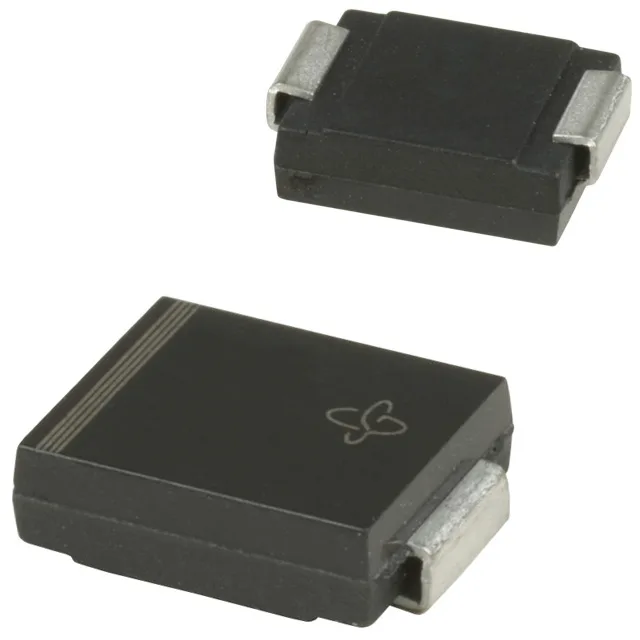
DO-214AB (SMC) body — the standard SMCJ footprint, so it lands on the same pad pattern as any SMC bidirectional TVS in this series. The cathode bar on the package marks polarity for the unidirectional direction; for the bidirectional variant the orientation is non-critical on AC lines.