Clamping voltage and the protection decision
The 1.5SMC8.2AHM3_A/I: The 12.1 V maximum clamping voltage at a 10/1000 µs peak pulse current of 124 A is the figure that decides whether a sensitive downstream load survives an automotive transient — it is the let-through voltage the protected circuit sees when the TVS is fully active. The standoff of 7.02 V sets the normal operating window — below this the TVS presents high impedance and draws only leakage current, leaving the rail clean for the load. When a surge exceeds the 7.79 V minimum breakdown, the Zener channel turns on hard and clamps the event to 12.1 V, shunting 124 A peak from the line before the downstream IC sees overstress — that gap between 7.79 V breakdown and 12.1 V clamping is the protection headroom the designer evaluates against the absolute-maximum rating of the load.
Peak pulse power and thermal margin
1.5 kW peak pulse rating defines the surge energy the device absorbs in a single 10/1000 µs event — at 124 A through a 12.1 V clamped voltage the device is processing roughly 1.5 kW for the duration of the pulse. Junction temperature is rated to 150 °C; the -65 °C lower limit covers cold-crank and cold-start scenarios in automotive deployments.
AEC-Q101 qualification for automotive deployments
The AEC-Q101 qualifier means this part has passed the automotive electronics council stress tests for discrete semiconductors — temperature cycling, high-temperature reverse bias, humidity, and mechanical shock — qualifying it for ECU power-rail protection in engine-compartment and cabin-domain applications.
DO-214AB package and surface-mount production note
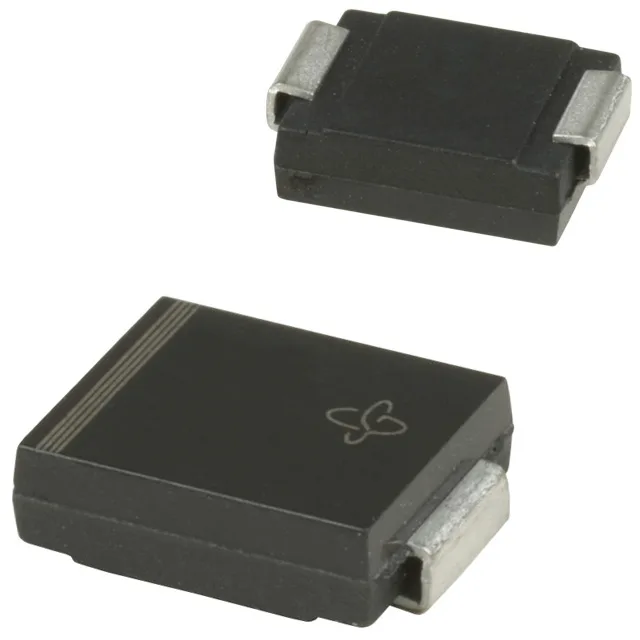
DO-214AB (SMC) is a common SMC footprint — the two-lead barrel-style package mounts on standard surface-mount lines with reflow profiles compatible with lead-free assembly. This is a unidirectional TVS — it clamps positive transients on one polarity only; a bidirectional protection need requires two of these in inverse series or a separate bidirectional part.