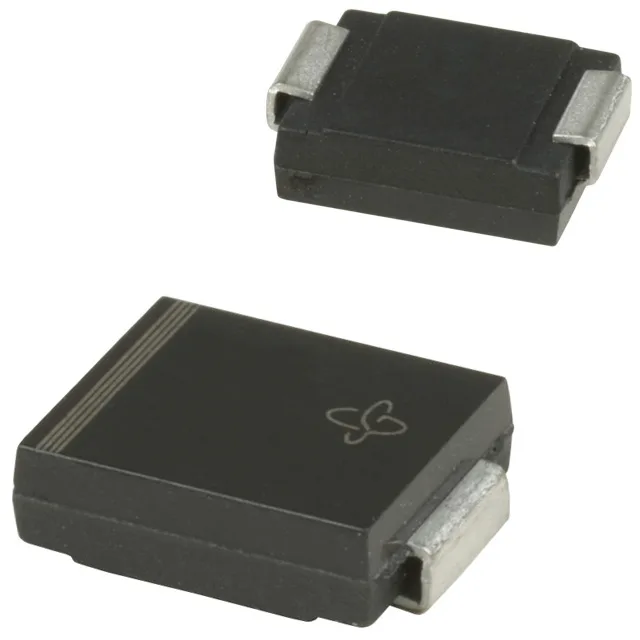
1500W peak pulse — what the clamping spec means
The 1.5SMC8.2AHM3/I: At that pulse width, the clamping voltage sits at 12.1V maximum with a 124A peak pulse current. That 12.1V ceiling is the voltage the protected node sees during the event — the lower the clamping ratio relative to the standoff, the less stress propagates downstream to the load. The 7.79V minimum breakdown voltage marks where the zener conduction kicks in — below it the device presents a high impedance and leaks minimally; above it the IV curve turns sharply and the TVS shunts the surge current to ground. For a 12V nominal rail the 7.02V reverse standoff gives comfortable headroom at idle; the 12.1V clamp ceiling accommodates the transient without letting the protected rail see more than it can tolerate.
AEC-Q101 grade and the automotive temperature envelope
AEC-Q101 qualification means the part passed the automotive stress-test sequence — including humidity, temperature cycling, and surge life — at the grade level required by tier-one ECU programs. For a TVS protecting an ECU input rail, this temperature range means the clamping characteristics remain within datasheet limits from a -40°C ambient soak up through the full thermal derate at 105°C engine-bay enclosure temperature.
SMC/DO-214AB surface-mount footprint
The DO-214AB (SMC) package is the mid-size SMC footprint — larger than the SMA (DO-214AC) and smaller than the SMB (DO-214AA). The cathode bar on the sleeve identifies the polarity end; the anode is the opposite side. The surface-mount form factor suits high-volume pick-and-place assembly with reflow profile compatibility to IPC/JEDEC J-STD-020. Tape-and-reel packaging on the 7-inch or 13-inch reel matches standard SMT feeder configurations for automotive EMS production runs.