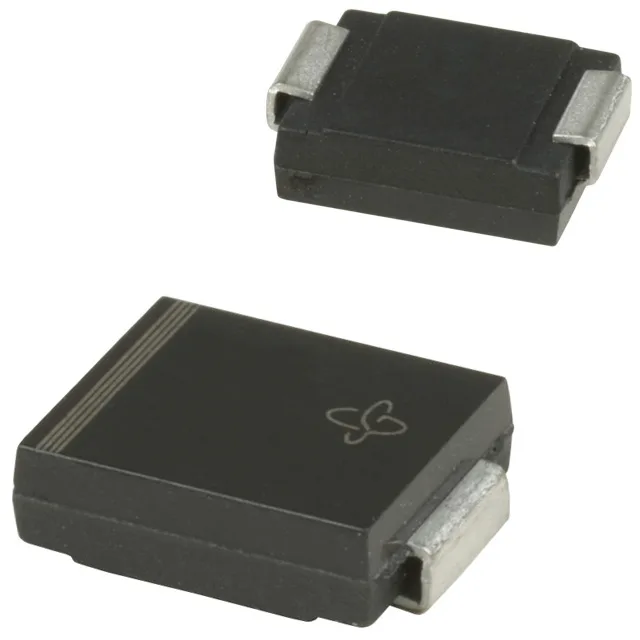
What the 1.5SMC8.2AHE3/9AT protects — and how hard it clamps
The 1.5SMC8.2AHE3/9AT is a unidirectional Zener-based TVS (Transient Voltage Suppressor), part of Vishay's 1.5SMC family qualified to AEC-Q101 for automotive environments. With a 1500 W peak pulse power rating at the 10/1000 µs wave shape, it absorbs transients that would exceed the working voltage of downstream circuitry on low-voltage rails. The reverse standoff voltage of 7.02 V typ is the working voltage the protected rail sits at during normal operation; the clamping voltage of 12.1 V max at the rated peak pulse current of 124 A is the ceiling the diode enforces when a transient fires. The minimum breakdown of 7.79 V sits between the two, giving the diode enough headroom above nominal to stay off during normal operation.
Peak pulse rating — what 124 A means in the field
Peak pulse current of 124 A at 10/1000 µs sets the fault energy the diode can survive before the clamping voltage climbs beyond the 12.1 V ceiling. A 1500 W rating at that wave shape is the product of the clamping voltage and the peak current — the diode dissipates the transient energy in roughly a millisecond window, so the 124 A figure is not a continuous current rating; it is a single-event survivability number. The clamping voltage of 12.1 V max means the protected node is held below 12.1 V even as the transient current reaches 124 A — the dynamic resistance of the Zener avalanche determines how much the clamping voltage climbs as current rises. For a 5 V rail with ±10% tolerance, 12.1 V sits above the 5.5 V absolute-maximum of most ICs but within the transient-withstand window of well-designed downstream stages.
Automotive qualification and sourcing posture
The AEC-Q101 qualification confirms this part has passed the automotive stress tests — temperature cycling, high-temperature reverse bias, and pulsed operation — required to be used in automotive modules without additional screening. The wide junction temperature range of -65 °C to 150 °C covers both cold-start and engine-compartment ambient conditions. The part is listed as Active in production. It ships on tape and reel per the supplier device package designation DO-214AB (SMCJ). Availability and lead time confirmed at RFQ through independent distribution channels carrying this Vishay General Semiconductor part.