What this part is and where it goes
The 1.5SMC8.2AHE3/57T: In an automotive ECU or power-rail node, it clamps inductive transients — load dumps, relay kickback, solenoid collapse — before the downstream IC sees them. The unidirectional polarity means it sits on the positive rail, shunting the spike to ground when the voltage exceeds the standoff threshold.
Peak pulse power and clamping — the numbers that matter
1500 W peak pulse (10/1000 µs waveform) is the headline rating — it tells you the diode survives a single transient event of that energy without degradation. At 124 A peak pulse current, the diode conducts hard during the event and the clamp voltage of 12.1 V holds the downstream bus within safe limits for the protected circuit. The protection window runs from 7.02 V reverse standoff (normal operating voltage, no conduction) through 7.79 V minimum breakdown (where the diode begins to conduct) to 12.1 V maximum clamping (the voltage the protected node sees at 124 A peak). A 5 V rail has roughly 2 V of headroom before the diode even starts to turn on.
Junction temperature and automotive thermal margin
AEC-Q101 qualification means the part passed temperature cycling, humidity bias, and surge testing per the automotive stress standard — the test report and PPAP documentation are what your quality team will ask for on an IATF 16949 build.
Package, mounting, and tape-and-reel packaging
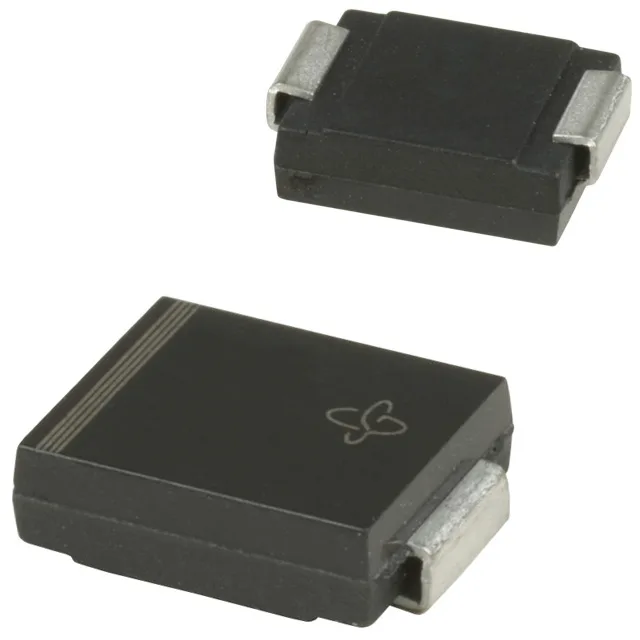
DO-214AB (SMC) is a three-terminal J-bend package — the central tab is the cathode (protection node), and the two outer leads are the anode return. The wide metal tab and exposed pad underside carry the thermal path; the landing pattern in the datasheet controls the thermal resistance from junction to board. Shipped on Tape & Reel (TR) — the standard format for automated pick-and-place on automotive SMT lines. Confirm reel count and leader/trailer length against your feeder capacity before the line is released.