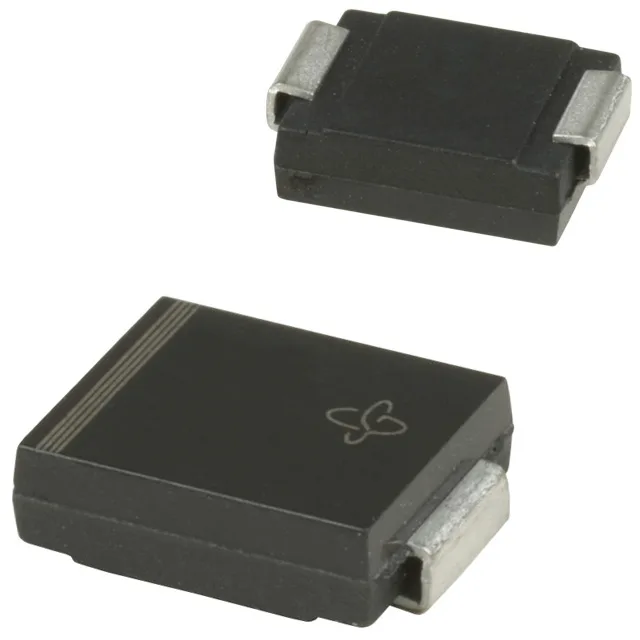
What 75V clamping means for your protection circuit
The 1.5SMC75CAHM3_A/I is a bidirectional transient voltage suppressor — the CA suffix marks it as a bidirectional unit, not a unidirectional polarity clamp. Reverse standoff of 64.1 V sets the continuous working voltage the circuit sees without conduction; the 71.3 V minimum breakdown is where it begins to clamp. At 14.6 A peak pulse (10/1000 µs waveform), the clamping voltage tops out at 104 V, so downstream semiconductors with a 75-80 V abs-max rating need headroom or a higher-standoff part. For telecom infrastructure sitting on 48 V rails, 64.1 V standoff sits comfortably above the nominal bus with enough margin for 20% overvoltage transients without idle conduction.
AEC-Q101 qualification for automotive deployments
The AEC-Q101 grade is the gate for automotive under-hood and chassis-domain procurement — it means the part passed temperature cycling, humidity bias, and surge life testing to the stress levels defined in the AEC-Q101 rev D user guide. For telecom outdoor units the same wide temperature rating covers extreme winter cold soak without specifying a separate commercial-temperature grade.
SMC body, tape-and-reel flow
The DO-214AB (SMC) is the mid-power TVS body. The cathode band marks the anode on the bidirectional CA variant — both ends look the same mechanically because the device is inherently bidirectional. Tape-and-reel packaging orients the part for automated pick-and-place; no orientation correction is needed for the CA bidirectional variant since both ends are electrically equivalent.