Clamping architecture — what 64.1V standoff, 71.3V breakdown and 104V clamping mean for the protection window
The 1.5SMC75CAHM3/I is a bidirectional TVS diode (Vishay calls it a TransZorb®) that clamps voltage spikes on a line without disturbing normal operation. The 64.1V reverse standoff rating is the continuous working voltage the line can sit at without the device conducting — the circuit runs below this at rest. The 1500W peak pulse power rating defines the surge energy the device can absorb at that exact waveform — a 10/1000µs pulse (10% pulse width, 1000µs duration) is the standard automotive transient test shape. The 14.6A peak clamping current at that waveform confirms the device handles the current spike that flows when the clamping voltage is reached; higher clamping voltages on the same standoff rating would imply a less efficient clamp with higher let-through energy. Because the diode is bidirectional, it clamps both polarities — positive transients on the signal line and negative ones relative to ground are both absorbed without requiring two unidirectional devices back-to-back.
Automotive qualification and thermal margin in the DO-214AB package
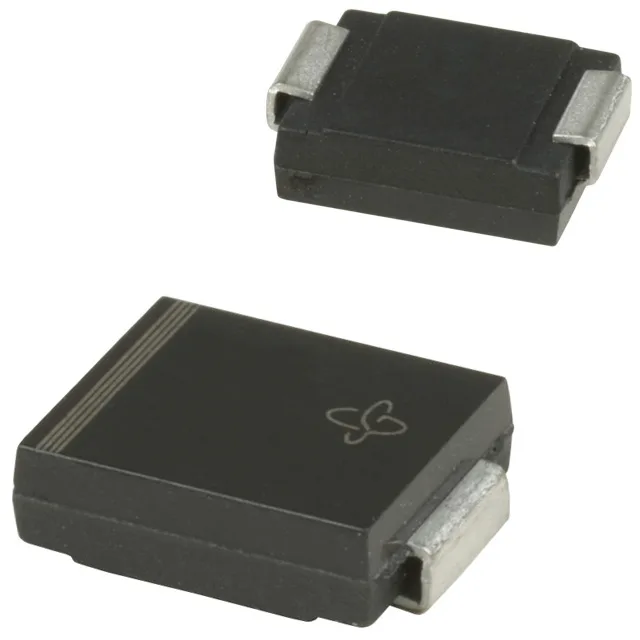
The AEC-Q101 qualification marks this as automotive-grade — the device passed the full stress battery (temperature cycling, high-temperature reverse bias, power temperature cycling, drop, vibration, solder heat resistance) required for discrete semiconductors in engine-compartment and chassis-adjacent applications. The DO-214AB (SMC) package is the standard surface-mount outline for 1500W TVS devices — the cathode tab provides a thermal path to the PCB pad. For a 1500W peak-rated part the land pattern matters: the pad under the tab should follow the Vishay recommended footprint to maintain the rated thermal resistance to the board. Tape-and-reel packaging confirms automated placement is the intended assembly route. The listed applications are Automotive and Telecom — these two markets share a common requirement for fast, repeatable clamping of load-dump transients (automotive) or lightning-surge events (telecom line cards), both of which the 10/1000µs surge rating covers. Power-line protection is listed as No — this part is not rated for direct AC mains bus protection.