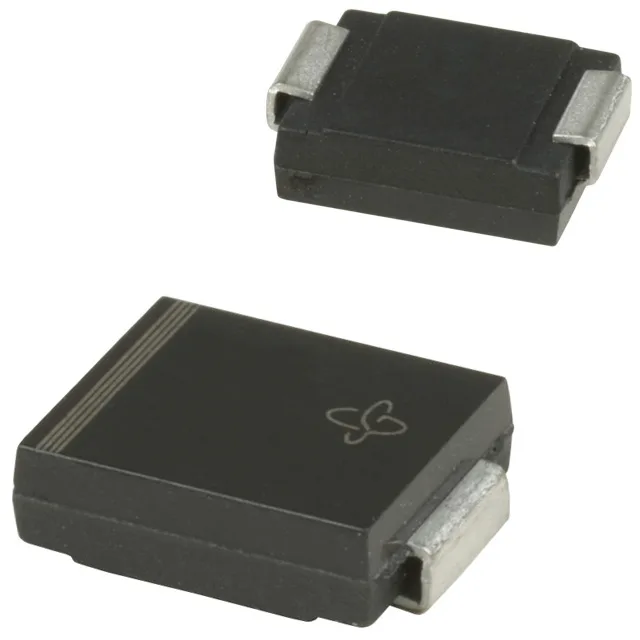
What 1500W peak pulse means for your protection circuit
The 1.5SMC75CAHM3/H: At that peak, the 14.6 A peak pulse rating tells you the current the diode must conduct while holding the rail at or below 104 V clamping maximum.
The protection window — standoff, breakdown, and clamping
A 64.1 V reverse standoff sets the normal working voltage: the protected rail runs below this without the diode conducting. Once a surge pushes the line above the 71.3 V minimum breakdown, the TVS avalanches and clamps. The 104 V clamping ceiling at peak pulse current is what the downstream IC sees during the event — so you size the IC's absolute-maximum input rating with headroom above 104 V, not just below 64.1 V.
The AEC-Q101 qualification means this part passed the automotive stress suite — humidity, temperature cycling, and surge life — and is design-qualified for safety-critical modules. For an engine-compartment ECU that sees 125°C ambient, the 150°C TJ ceiling still leaves margin.
Bidirectional, SMC package, tape-and-reel
The CA suffix confirms a single bidirectional TVS — it clamps both positive and negative transients on the same node, which is what you need on an unsymmetrical power rail that floats or has a shared ground reference. The DO-214AB (SMC) surface-mount package with tape-and-reel packaging fits standard automotive pick-and-place lines; confirm the land pattern against the DO-214AB footprint in the datasheet before committing to the layout, especially for thermal pad termination.
Active lifecycle — sourcing against an RFQ
The part carries Active status from Vishay General Semiconductor — Diodes Division.