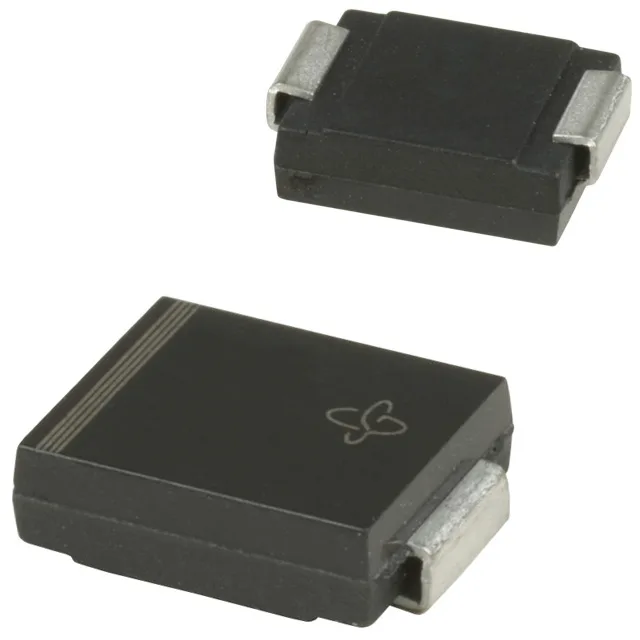
Vishay General Semiconductor - Diodes Division 1.5SMC75CAHE3/57T — Circuit Protection

1.5SMC75CAHE3/57T TVS Diode, 64.1V Standoff, AEC-Q101

MPN1.5SMC75CAHE3/57T
Active

Vishay General Semiconductor, 1.5SMC75CAHE3/57T, automotive TVS Zener, bidirectional, 64.1V standoff, 71.3V min breakdown, 104V clamping, 1500W peak pulse, 14.6A peak pulse current, DO-214AB SMC, AEC-Q101, surface mount, -65 to 150°C junction, tape & reel.

Independent supplier — new & surplus stockAuthenticity-screened · ESD-safe packingListing updated Aug 2026

Specifications

1.5SMC75CAHE3/57T specifications
ParameterValue
TypeZener
SeriesAutomotive, AEC-Q101, 1.5SMC, TransZorb®
MountingSurface Mount
Voltage - breakdown71.3V
Voltage - clamping (Max) @ ipp104V
Voltage - reverse standoff64.1V
Current - peak pulse (10/1000μs)14.6A
Power - peak pulse1500W (1.5kW)
Power line protectionNo
Operating temperature-65°C~150°C(TJ)
PackageTape & Reel (TR); Cut Tape (CT)
ApplicationsAutomotive
CaseDO-214AB, SMC
Bidirectional channels1

Product details

Standoff, breakdown, and clamping — the working window

The 1.5SMC75CAHE3/57T: The reverse standoff of 64.1 V typ sets the continuous working voltage below which the TVS is off and draws only leakage. Breakdown kicks in no lower than 71.3 V min, and during a surge the clamping voltage at the peak pulse current does not exceed 104 V max. That roughly 40 V window between standoff and clamping is where the downstream circuitry sees protection headroom during automotive load-dump or inductive dump transients. Peak pulse current at that same waveform is 14.6 A. Verify your surge waveform matches the 10/1000 µs shape; a faster or slower transient changes the energy the part sees.

Junction temperature and the automotive thermal envelope

Junction operating range runs to 150°C, starting at -65°C. That covers the under-hood profile — engine-bayECU, chassis-node, and 24V commercial-vehicle rails all sit within that window. The AEC-Q101 qualification means the part passed the temperature-cycle, bias, and power-temperature stress screens required for automotive safety-critical deployments.

Frequently asked questions

What compliance documentation does Vishay provide for 1.5SMC75CAHE3/57T?

The part carries the AEC-Q101 automotive qualification, confirming it passed the automotive stress screens. Additional compliance documentation — REACH, RoHS, or UL — is not listed in the current spec record; request the CoC or full datasheet at RFQ if program-level documentation is required.